The diseases of the stomach : with an introduction on its anatomy and physiology, being lectures delivered at St. Thomas's Hospital / by William Brinton.
- William Brinton
- Date:
- 1859
Licence: Public Domain Mark
Credit: The diseases of the stomach : with an introduction on its anatomy and physiology, being lectures delivered at St. Thomas's Hospital / by William Brinton. Source: Wellcome Collection.
Provider: This material has been provided by the Francis A. Countway Library of Medicine, through the Medical Heritage Library. The original may be consulted at the Francis A. Countway Library of Medicine, Harvard Medical School.
41/426 page 25
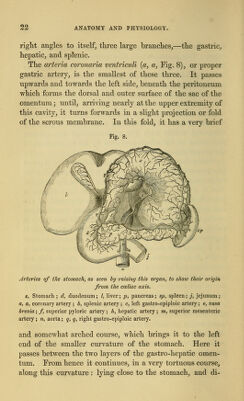
![corresponding vessel on tli(3 right side, supplying brand] to both surfaces of the stomach. The vasa brevia (at e, Fig. 8) arc small branches which come from the primary and secondary divisions of the splenic artery, and run in the gastro-splcnic omentum to the cardiac pouch. Here they break up and anastomi with each other, as well as with the coronary and left gastro-epiploic arteries. The veins of the stomach arc the superior pyloric, and the rigid and left gastro-epiploic. The vena pylorica superior receives and continues a large vein, which corresponds to the coronary artery, and tak a similar (but reversed) course along the lesser curvature of the stomach to the pylorus. It now passes upwards for a little distance, before opening into the vena portce near its termination in the liver. In some instances, it ben down to join the splenic vein. The vena gastro-epiploica deoctra corresponds to the artery in the greater part of its distribution. It usually ends by emptying itself into the superior mesenteric vein, just before this forms the vena portce by joining with the splenic vein. The vena gastro-epiploica sinistra also runs with its artery, and joins either the splenic vein, or one of its primary branches. All of the foregoing vessels are characterised by the great freedom and frequency of their inosculations, in every stage of their course from the aortic to the portal trunks. This condition is especially well marked in the arteries, which in number and size far exceed those dis- tributed to an equal bulk of most of the other structures of the body. This fact is doubtless connected, not merely with the large supply of blood they send the stomach, but also with a smaller resistance, and greater velocity, in their channels; and especially with that efficient and](https://iiif.wellcomecollection.org/image/b21043589_0041.jp2/full/800%2C/0/default.jpg)