Licence: Public Domain Mark
Credit: The formula of morphine / by R.B. Dott and Ralph Stockman. Source: Wellcome Collection.
Provider: This material has been provided by the Royal College of Physicians of Edinburgh. The original may be consulted at the Royal College of Physicians of Edinburgh.
4/8 (page 2)
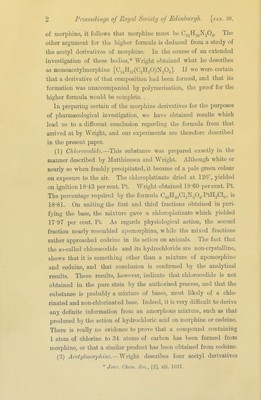
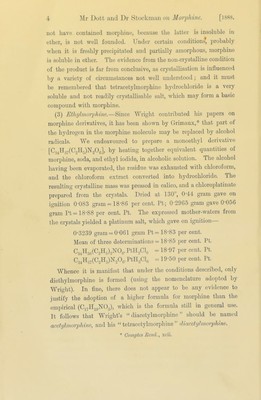
![of morphine, it follows that morphine must be Cg^EggNgOg. The other argument for the higher formula is deduced from a study of the acetyl derivatives of morphine. In the course of an extended investigation of these bodies,* Wright obtained what he describes as monoacetylmorphine [C.,4H3.(C2H30)N20^.]. If we were certain that a derivative of that composition had been formed, and that its formation was unaccompanied by polymerisation, the proof for the higher formula would be complete. In preparing certain of the morphine derivatives for the purposes of pharmacological investigation, we have obtained results which lead us to a different conclusion regarding the formula from that arrived at by Wright, and our experiments are therefore described in the present paper. (1) Chlorocodide.—This substance was prepared exactly in the manner described by Matthiessen and Wright. Although white or nearly so when freshly precipitated, it became of a pale green colour on exposure to the air. The chloroplatinate dried at 120°, yielded on ignition 18-43 percent. Pt. Wright obtained 18-60 percent. Pt. The percentage required by the formula CggH^oClgNgO^.PtHgCl,,, is 18-81. On uniting the first and third fractions obtained in puri- fying the base, the mixture gave a chloroplatinate which yielded 17'97 per cent. Pt. As regards physiological action, the second fraction nearly resembled apomorphine, w hile the mixed fractions rather approached codeine in its action on animals. The fact that the so-called chlorocodide and its hydrochloride are non-crystalline, shows that it is something other than a mixture of apomorphine and codeine, and that conclusion is confirmed by the analytical results. These results, however, indicate that chlorocodide is not obtained in the pure state by the authorised process, and that the substance is probably a mixture of bases, most likely of a chlo- rinated and non-chlorinated base. Indeed, it is very difficult to derive any definite information from an amorphous mixture, such as that produced by the action of hydrochloric acid on morphine or codeine. There is really no evidence to prove that a compound containing 1 atom of chlorine to 34 atoms of carbon has been formed from morphine, or that a similar product has been obtained from codeine. (2) Acetylmorphine.—Wright describes four acetyl derivatives * Jour. Chan. Soc, [2], xii. 1031.](https://iiif.wellcomecollection.org/image/b2190182x_0004.jp2/full/800%2C/0/default.jpg)