Licence: Public Domain Mark
Credit: The formula of morphine / by R.B. Dott and Ralph Stockman. Source: Wellcome Collection.
Provider: This material has been provided by the Royal College of Physicians of Edinburgh. The original may be consulted at the Royal College of Physicians of Edinburgh.
6/8 (page 4)
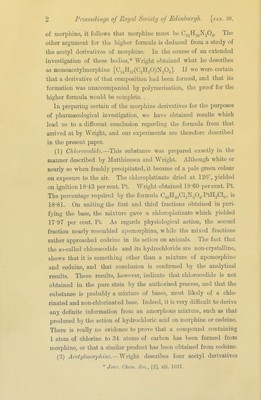
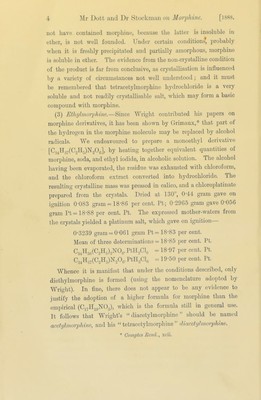
![not have contained morphine, because the latter is insohible in ether, is not well founded. Under certain conditions, probably when it is freshly precipitated and partially amorphous, morphine is soluble in ether. The evidence from the non-crystalline condition of the product is far from conclusive, as crystallisation is influenced by a variety of circumstances not well understood ; and it must be remembered that tetracetylmorphine hydrochloride is a very soluble and not readily crystallisable salt, which may form a basic compound with morphine. (3) EthyhnoriMne.—Since Wright contributed his papers on morphine derivatives, it has been shown by Grimaux,* that part of the hydrogen in the morphine molecule may be replaced by alcohol radicals. We endeavoured to prepare a monoethyl derivative [C34H3^(C2H5)N206], by heating together equivalent quantities of morphine, soda, and ethyl iodide, in alcoholic solution. The alcohol having been evaporated, the residue was exhausted with chloroform, and the chloroform extract converted into hydrochloride. The resulting crystaUine mass was pressed in calico, and a chloroplatinate prepared from the crystals. Dried at 130, 0-44 gram gave on ignition 0-083 gram = 18-86 per cent. Pt; 0 2965 gram gave 0*056 gram Pt = 18-88 per cent. Pt. The expressed mother-waters from tlie crystals yielded a platinum salt, which gave on ignition— 0-3239 gram = 0-061 gram Pt= 18-83 per cent. Mean of three determinations = 18-85 per cent. Pt. C3,H3,(C2H5)2NOo.PtH^Cl, = 18-97 per cent. Pt. C34H3.(C2H,)N20e,PtH2Cl, 19-50 per cent. Pt. Whence it is manifest that under the conditions described, only diethylmorphine is formed (using the nomenclature adopted by Wright). In fine, there does not appear to be any evidence to justify the adoption of a higher formula for morphine than the empirical (CiyH^gNOg), which is the formula still in general use. It follows that Wright's diacetylmorphine should be named acetylmorphine, and bis tetracetylmorphine cUacetylmorphine. * Comptes Rend., xcii.](https://iiif.wellcomecollection.org/image/b2190182x_0006.jp2/full/800%2C/0/default.jpg)