A history of classical Greek literature / by J.P. Mahaffy.
- John Pentland Mahaffy
- Date:
- 1910
Licence: In copyright
Credit: A history of classical Greek literature / by J.P. Mahaffy. Source: Wellcome Collection.
37/262 page 27
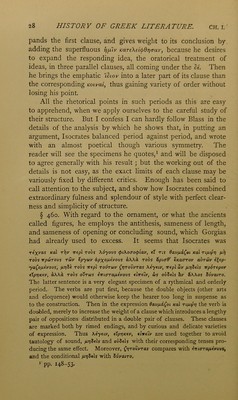
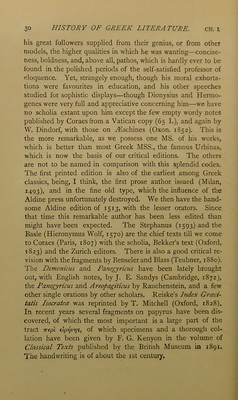
![THE PERIODS OF ISOCRATES. though unfortunately we have no rules left us by the master himself as to his usage in this respect. Our earliest authority is the suspected third book of Aristotle’s Rhetoric^ from which we learn that a period in prose is like a strophe in verse, a com- plete unity, including various members under it, but as a whole easily grasped and satisfying to the mind. By the aid of a suspended grammatical construction, and of adversative or con- necting particles, a very long sentence can thus be brought into a well-balanced and harmonious system; but the poetical period is stricter in form; the prose period only varies the length and weight of its members, in order that the thought may also be rounded off and complete. It is evident from the careful survey of sentences by Blass ^ that very great variety was admitted, both as to the number of the clauses and their rela- tive lengths, in Isocrates’ periods. In fact, instead of the obvious antithesis of equally balanced clauses (such as those so com- mon in Gorgias and in our Gibbon), he used a larger and more complicated harmony, in which we caii now only wonder at the effect, and enumerate the elements, without being able to ex- tract from them the law—if law it was, and not a cultivated instinct—which guided him in his practice. Certain it is that we often find a thought expanded for the sake of fuller expression, and that this insistance upon formal harmony wearies the reader who desires to hurry onward to a new thought But if there was one thing wholly strange and odious to Isocrates, it was hurry in thinking or speaking. Let us quote a specimen. In the Panegyricus he wishes to say (as a sequel to his undertaking that he will exceed all former speeches), that while our ancestral glories are common property to all, the highest treatment of them is a peculiar gift, and oratory would indeed flourish if admiration was bestowed not on the first inventors of speech, but on those who have brought it to perfection. How does he express this idea ? ^ He ex- ' AB. ii. pp. 147, sq. * §§ 9-^0 ^ M**' y^P at irpoyeyevqiJ.evai KoivaX iraffiv 7]/uy KaT(\tl<p0T}(Tav, rh S' iv Kaiptp ravrais Karaxp'flo'aaOat Kal ra irpocrfiKOVTa wtp\ iKdarris iv0uixi}0Tivai KoX rots ov6fxa<nv SiaOecrdat raip eZ (ppovavvrw fSi6y icTTty. ijyovfxai S’ ovtccs h,v fxfylarrtp iiriSotrip KapL^ipap Kal ras &\Xat](https://iiif.wellcomecollection.org/image/b24867949_0037.jp2/full/800%2C/0/default.jpg)




 No text description is available for this image
 No text description is available for this image
 No text description is available for this image