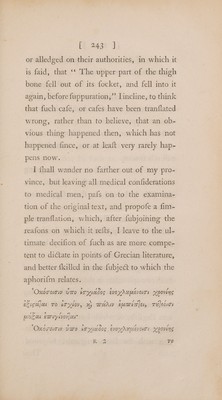
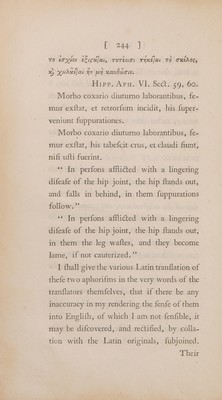
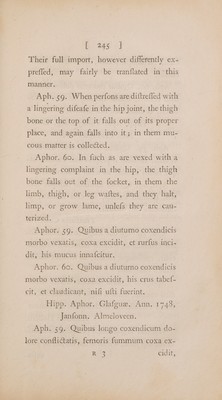
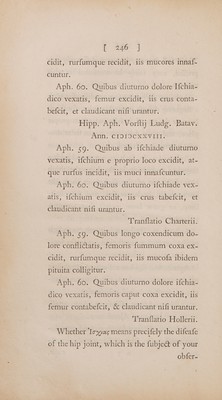
Observations on the disease of the hip joint; to which are added, some remarks on white swellings of the knee, the caries of the joint of the wrist and other similar complaints; the whole illustrated by cases, and engravings taken erom [sic] the diseased parts / By Edward Ford.
- Edward Ford
- Date:
- 1794
Licence: Public Domain Mark
Credit: Observations on the disease of the hip joint; to which are added, some remarks on white swellings of the knee, the caries of the joint of the wrist and other similar complaints; the whole illustrated by cases, and engravings taken erom [sic] the diseased parts / By Edward Ford. Source: Wellcome Collection.
276/306 page 248
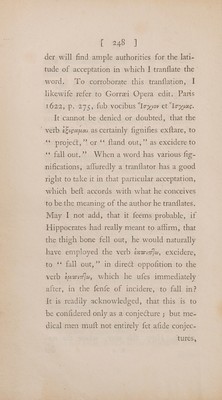
![der will find ample authorities for the lati- tude of acceptation in which I tranflate the’ word. To corroborate this tranflation, I likewife refer to Gorrei Opera edit. Paris 1622, p. 275, fub vocibus Icyuov et “Irnes. It‘ cannot be denied or doubted, that the verb EX ic ospects as certainly fignifies exftare, to ‘« project,’ or ‘‘ ftand out,”’ as excidere to ‘© fall out.”? When a word has various fig- nifications, afluredly a tranflator has a good right to take it in that particular acceptation, which beft accords with what he conceives to be the meaning of the author he tranflates. May I not add, that it feéms probable, if Hippocrates had really meant to affirm, that the thigh bone fell out, he would naturally have employed the verb exwizJw, excidere, to ‘‘ fall cut,” in direct oppofition to the verb euaiz]o, which he ufes immediately after, in the fenfe of incidere, to fall in? It is readily acknowledged, that this is to be confidered only as a conjecture ; but me- dical men muft not entirely fet afide conjec- tures,](https://iiif.wellcomecollection.org/image/b33086308_0276.jp2/full/800%2C/0/default.jpg)