Researches into the action of mercury, podophylline, and taraxacum on the biliary secretion : being the report of the Edinburgh Committee of the British Medical Association / by John Hughes Bennett.
- John Hughes Bennett
- Date:
- 1869
Licence: Public Domain Mark
Credit: Researches into the action of mercury, podophylline, and taraxacum on the biliary secretion : being the report of the Edinburgh Committee of the British Medical Association / by John Hughes Bennett. Source: Wellcome Collection.
Provider: This material has been provided by The University of Glasgow Library. The original may be consulted at The University of Glasgow Library.
25/52 (page 207)
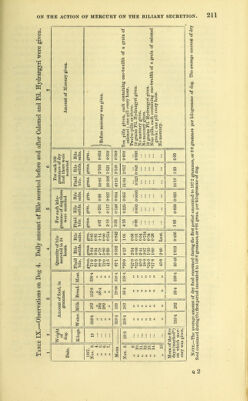
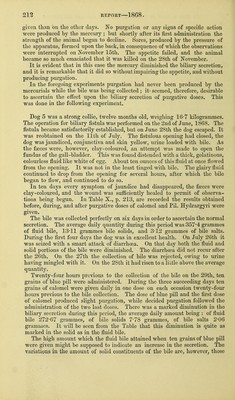
![Pil. Hydrargyri was again given. Extraordinary variations occurred in the amonnt of bile obtained during its exhibition, and the quantities appear to show that the secretion of bile was diminished; but they are in truth ren- dered valueless by the circumstance that a considerable quantity of bile Avas separated by the kidneys, owing, most probably, to its free exit by the fistula having been interfered with. The animal was never purged until July 30th, when it twice passed a considerable quantity of liquid faBces. Although it did not lose weight to any notable extent during the period embraced by Table Y., its strength diminished. In order that the dog might rally, the observations were suspended, and a more liberal diet allowed. It grew gra- dually weaker, however, and died on the 5th of August. On dissection a layer of recent lymph was found over the whole surface of the peritoneum. The cause of the peritonitis was not evident *. Observations with Calomel. The second dog (No. 2), with a biliary fistula, was a full-grown half-bred collie, weighing 15-6 kilogrammes. The operation was performed on the 5th of September, 1867. The wound healed perfectly, and collection of the bile was begun on the 20th of September. The general health of the animal was, however, indifferent; its appetite was uncertain, and its general strength feeble. When the apparatus was applied, the animal appeared to be much distressed by its weight, and by the constriction of the thorax and abdo- men, which its proper application rendered necessary. After the operation the f£eces became clay-coloured. During seven days, from September 21st to 27th inclusive, observations were made with, a view to determine the normal secretion of bile : the results are given in the following Table (Table YI.) :— Table YT.—Pirst Series of Observations on Dog 2. Daily amount of Bile secreted without Mercury. 1 2 3 4 5 6 Date. Weight of dog. Amount of food, grammes. in Quantity of bile secreted in 24 hours. For each kilo- gramme of dog there were secreted For each 100 grammes of dry food there were secreted Kilogs. Water. Milk. Bread. Meat. Fluid bile. Bile solids. Bile salts. Fluid bile. Bile solids. Bile salts. Fluid bile. Bile solids. Bile salts. 1867. Sept. 21. „ 22. „ 23. 15-6 ISTone. rNota J State jscar (ken. None. Has onl 561 584 ccura ment cely None. tely no in book any foo None. ted ^ is f dta- r grms. 130 81 94-15 grms. 7-29 4-48 6'072 grm. 1-41 0- 907 1- 205 grma. 8-333 grm. 0-467 grm. 0-09 grms. 230-0 grms, 12-9 grms. 2-51 „ 24 „ 25. „ 26. „ 27. 15'6 225-6 282 197-4 y tak None, en a litt None. 310-2 225 lemilk 94-70 78-80 62-50 35-50 5-750 5-92 5-70 ]-99 1-01 1-25 1-08 0-436 2-27 0-12 0-027 73-9 5-60 1-18 82-46 5-31 1042 5-27 0-34 0-066 Note.—On the 25th September the dry food consumed amounted to 105-7 grammes, or 6-7 grms. per kilog. of dog; on the 21st, 56-4 grms., or 3-6 grms. per kilog. of dog. In this Table, as well as in several others, it will be observed that the amount of bile collected was greater on the first than on other days—a rule, however, by no means invariable. The occurrence was probably due to the canula having permitted a freer exit to the bile than the fistulous opening * For further observations on the action of Pil. Hydrargyri see Tables IX. and X.](https://iiif.wellcomecollection.org/image/b21480321_0027.jp2/full/800%2C/0/default.jpg)