Researches into the action of mercury, podophylline, and taraxacum on the biliary secretion : being the report of the Edinburgh Committee of the British Medical Association / by John Hughes Bennett.
- John Hughes Bennett
- Date:
- 1869
Licence: Public Domain Mark
Credit: Researches into the action of mercury, podophylline, and taraxacum on the biliary secretion : being the report of the Edinburgh Committee of the British Medical Association / by John Hughes Bennett. Source: Wellcome Collection.
Provider: This material has been provided by The University of Glasgow Library. The original may be consulted at The University of Glasgow Library.
7/52 page 191
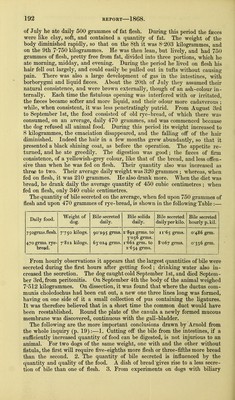
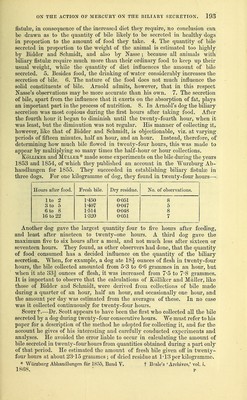
![first or second hour after feeding, the other so much the earlier the more scanty the supply of food. In Bidder and Schmidt's tabulated observations on the first dog, it will be seen that the greatest amount of fresh bile was secreted between six and seven hours after a meal. It is true that the greater amount of dry biliary residue was found in one of the collections made from fourteen and a half to fifteen and a half hours after feeding; but in another quantity collected at the same period after feeding the amount both of fresh bile and dry residue was much less than that collected between six and seven hours after a meal. Again, of two quantities collected respectively on the 2nd and 6th of Novem- ber, from fourteen to fifteen and a half hours after feeding, the amount of fresh bile in the first collection was only about the half of what was secreted from three to four hours after a meal; and in the second collection it was about half of that secreted from four and a half to five and a half hours after a meal. The tabulated observations on the third dog seem to give more support to Bidder and Schmidt's opinion; but quantities of biliary secretion given for different periods after feeding are too fiuctuating to permit the amount of bile secreted at any given stage of digestion to be accurately estimated. The observations of Bidder and Schmidt themselves, therefore, do not support their own conclusion; and as this is opposed to those of other experimenters, it must be concluded that the amount of bile secreted varies considerably in the same animal, and at the same period of digestion, even independently of food and drink. Arnold*.—In 1854 Dr. Arnold published a work on the * Physiology of the Bile,' and afterwards made some additional experiments on the subject in 1857. The apparatus he employed consisted of a canula 4| centimetres long and 4 centimetres wide, attached by a screw to an elastic caoutchouc bag 10 centimetres long and 1 centimetre broad. Fifteen millimetres above this attachment, and at right angles with the canula, was a metallic plate, 12 millimetres in diameter. This plate was placed between the skin and the muscles ; and the wound healed perfectly over it, preventing all escape of bile between the soft parts and the canula. The distal extremity of the bag had a cork stopper, by taking out which the bile collected in it could be removed. The operation was performed in the usual manner on a healthy dog of middle size, weighing 9*250 kilogrammes, on the 18th of June, 1853. The common duct was first tied close to the duodenum, and again half an inch from the gut. The portion between the two ligatures was then excised. Although after the operation the dog was exhausted, and vomited its food more than once, on the following day he appeared to be quite well. The bile flowed freely through the canula until July 1st, when it ceased. Another and wider canula, with a broader border, was then inserted. This also, sub- sequently, was so forced forwards by the contraction of the wound that no bile could flow, and the canula was withdrawn. The apparatus first in- serted was then employed, and answered perfectly, as the canula was firmly fixed in its place by the wound healing over it; so that not a drop of bile escaped at its edges. From the ]8th of June until the 6th of July, the dog was fed on bread, milk, flesh, and potatoes. It lost 375 grammes in weight during this period, without any perceptible derangement of digestion. The faeces were pultaceous, without any trace of bile-pigment, had a putrid odour, and contained a considerable quantity of fat, but no trace of muscular fibre. To prevent him from licking the bile he was muzzled. From July 6th to August 2nd he was fed entirely on flesh. From the 6th to the 9th * Zur Physiologie der Galle, 4to, Mainz, 1854.](https://iiif.wellcomecollection.org/image/b21480321_0009.jp2/full/800%2C/0/default.jpg)

 No text description is available for this image
 No text description is available for this image
 No text description is available for this image