Obstetrical statistics, &c : a second letter in reply to Dr. Collins, President of the King and Queen's College of Physicians, Ireland, &c., &c., &c. / by J.Y. Simpson.
- James Young Simpson
- Date:
- 1848
Licence: Public Domain Mark
Credit: Obstetrical statistics, &c : a second letter in reply to Dr. Collins, President of the King and Queen's College of Physicians, Ireland, &c., &c., &c. / by J.Y. Simpson. Source: Wellcome Collection.
Provider: This material has been provided by The University of Glasgow Library. The original may be consulted at The University of Glasgow Library.
8/28 page 6
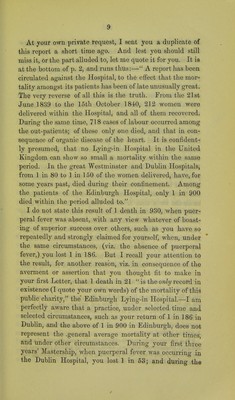
![Dublin Journal for 1838, and to which you refer in your first Letter to me. And you must kindly excuse me, if I defend the respected memory of Dr Mackintosh from the odium of calumniating his brother practitioners, by having made the improper and unworthy assertion which you choose to attribute to him. The printed Annual Reports of the Edinburgh Lying-in ' Hospital show, that, in 1821, 190 women were delivered within the Hospital. Of these 7 died; or 1 in 27. In 1822, 168 women were delivered within the Hospital. Of ' these 5 died, or 1 in 33. During these two years, out of 358 women delivered within the Hospital, 12 died, or ' nearly 1 in 30. But, secondly, These 12 women did die, as I have stated, ^ of epidemic puerperal fever. It grieves me, and it must, I i am sure, grieve all your best friends and weU-wishers, to see i you anxious to deny this. As your authority, you your- ; self refer me to Dr Mackintosh's Essay (1823). Well, in \ that work, Dr Mackintosh gives the following summary of ' the symptoms in the seven women that died in the Hospi- i tal in 1821:— They had,'' he says, rigors; pain of ab- \ domen and of forehead; progressive increase of pulse; ; difficulty of breathing; anxiously expressive countenances; | tumefaction of abdomen. The lochiae were not suppressed; I on the contrary, they flowed in natural quantity and qua- j lity. (P. 39.) Two pages further on (p. 41), Dr Mackin- 1 tosh states that the five patients who died in the Hospital j in 1822, had analogous symptoms. Surely no obstetric i pathologist or practitioner would or could say, that these i cases, with these symptoms, were not cases of puerperal j fever, as you and I, and all of us understand that generic | nosological term.* On this point, I unhesitatingly appeal to Dr Collins himself, but not to the writer (scriptor prce- A difference in the name makes no difference in the thing named. You j call the disease puerperal fever in your Treatise. I sometimes give it | the double name, puerperal fever and inflammation, as mai-king the two ] principal morbid actions which co-exist, not as cause and effect, but](https://iiif.wellcomecollection.org/image/b21475222_0008.jp2/full/800%2C/0/default.jpg)



 No text description is available for this image
 No text description is available for this image
 No text description is available for this image