Report of the Biotechnology Science Advisory Committee of the U.S. Environmental Protection Agency / the Committee.
- United States. Environmental Protection Agency. Biotechnology Science Advisory Committee.
- Date:
- 1987
Licence: Public Domain Mark
Credit: Report of the Biotechnology Science Advisory Committee of the U.S. Environmental Protection Agency / the Committee. Source: Wellcome Collection.
35/72 page 27
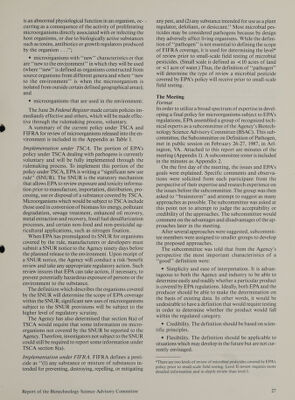
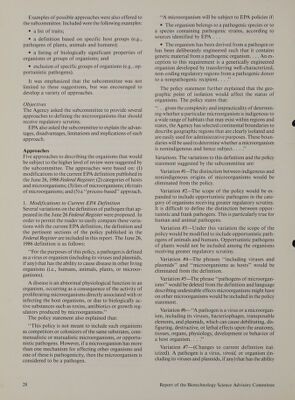
![is an abnormal physiological function in an organism, oc- - curring as a consequence of the activity of proliferating microorganisms directly associated with or infecting the host organisms, or due to biologically active substances such as toxins, antibiotics or growth regulators produced by the organism .. .”’; ® microorganisms with ‘‘new”’ characteristics or that are ‘‘new to the environment”’ in which they will be used (where “‘new’’ is defined as organisms constructed from source organisms from different genera and where ‘‘new to the environment’’ is when the microorganism is isolated from outside certain defined geographical areas); and ¢ microorganisms that are used in the environment. The June 26 Federal Register made certain policies im- mediately effective and others, which will be made effec- tive through the rulemaking process, voluntary. A summary of the current policy under TSCA and FIFRA for review of microorganisms released into the en- vironment is included in the Appendix as Table 1. Implementation under TSCA. The portion of EPA’s policy under TSCA dealing with pathogens is currently voluntary and will be fully implemented through the rulemaking process. To implement this portion of the policy under TSCA, EPA is writing a ‘‘significant new use rule’? (SNUR). The SNUR is the statutory mechanism that allows EPA to review exposure and toxicity informa- tion prior to manufacture, importation, distribution, pro- cessing, use or disposal of a substance covered by TSCA. Microorganisms which would be subject to TSCA include those used in conversion of biomass for energy, pollutant degradation, sewage treatment, enhanced oil recovery, metal extraction and recovery, fossil fuel desulfurization processes, and certain non-food and non-pesticidal ag- ricultural applications, such as nitrogen fixation. When EPA has promulgated its SNUR for organisms covered by the rule, manufacturers or developers must submit a SNUR notice to the Agency ninety days before the planned release to the environment. Upon receipt of a SNUR notice, the Agency will conduct a risk/benefit review and take any appropriate regulatory action. Such review insures that EPA can take action, if necessary, to prevent potentially hazardous exposure of persons or the environment to the substance. The definition which describes the organisms covered by the SNUR will determine the scope of EPA coverage within the SNUR; significant new uses of microorganisms subject to the SNUR provisions will be subject to the higher level of regulatory scrutiny. The Agency has also determined that section 8(a) of TSCA would require that some information on micro- organisms not covered by the SNUR be reported to the Agency. Therefore, investigators not subject to the SNUR could still be required to report some information under TSCA section 8(a). Implementation under FIFRA. FIFRA defines a pesti- cide as ‘‘(1) any substance or mixture of substances in- tended for preventing, destroying, repelling, or mitigating Report of the Biotechnology Science Advisory Committee any pest, and (2) any substance intended for use as a plant regulator, defoliant, or desiccant.’ Most microbial pes- ticides may be considered pathogens because by design they adversely affect living organisms. While the defini- tion of ‘‘pathogen’’ is not essential to defining the scope of FIFRA coverage, it is used for determining the level* of review prior to small-scale field testing of microbial pesticides. (Small scale is defined as <10 acres of land or <1 acre of water.) Thus, the definition of ‘‘pathogen’’ will determine the type of review a microbial pesticide covered by EPA’s policy will receive prior to small-scale field testing. The Meeting Format In order to utilize a broad spectrum of expertise in devel- oping a final policy for microorganisms subject to EPA’s regulations, EPA assembled a group of recognized tech- nical experts as a subcommittee of the Agency’s Biotech- nology Science Advisory Committee (BSAC). This sub- committee, the Subcommittee on Definition of Pathogen, met in public session on February 26-27, 1987, in Arl- ington, VA. Attached to this report are minutes of the meeting (Appendix 1). A subcommittee roster is included in the minutes as Appendix 2. On the first day of the meeting, the issues and EPA’s goals were explained. Specific comments and observa- tions were solicited from each participant from the perspective of their expertise and research experience on the issues before the subcommittee. The group was then asked to ‘‘brainstorm’’ and attempt to suggest as many approaches as possible. The subcommittee was asked at this point not to attempt to judge the acceptability or credibility of the approaches. The subcommittee would comment on the advantages and disadvantages of the ap- proaches later in the meeting. After several approaches were suggested, subcommit- tee members were assigned to smaller groups to develop the proposed approaches. The subcommittee was told that from the Agency’s perspective the most important characteristics of a ‘‘99od’’ definition were: e Simplicity and ease of interpretation. It is advan- tageous to both the Agency and industry to be able to determine easily and readily whether a particular product is covered by EPA regulations. Ideally, both EPA and the producer should be able to make the determination on the basis of existing data. In other words, it would be undesirable to have a definition that would require testing in order to determine whether the product would fall within the regulated category. e Credibility. The definition should be based on scien- tific principles. e Flexibility. The definition should be applicable to situations which may develop in the future but are not cur- rently envisaged. policy prior to small-scale field testing. Level I] review requires more detailed information and in-depth review than level I. 2a](https://iiif.wellcomecollection.org/image/b32230126_0035.jp2/full/800%2C/0/default.jpg)
 No text description is available for this image
 No text description is available for this image
 No text description is available for this image