A theoretical and practical treatise on the diseases of the skin / by P. Rayer.
- Pierre François Olive Rayer
- Date:
- 1845
Licence: Public Domain Mark
Credit: A theoretical and practical treatise on the diseases of the skin / by P. Rayer. Source: Wellcome Collection.
Provider: This material has been provided by the National Library of Medicine (U.S.), through the Medical Heritage Library. The original may be consulted at the National Library of Medicine (U.S.)
25/582
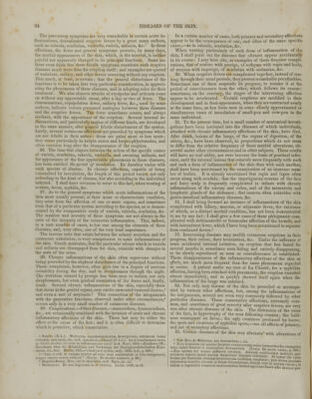
![A TREATISE ON THE DISEASES OF THE SKIN. CLASSIFICATION. 1. In this work I comprise, under the general title of Diseases of the Skin, every morbid condition which shows itself on the exterior of the body by some distinguishing character. Many of these affections are preceded, accompanied or followed, by lesions of one or more of the other tissues, and occasionally by modification of the general cir- culating fluid; the alteration of the skin, which is assumed as cha- racterizing them, is, in fact, only one of their more evident features. 2. The study of the diseases of the skin demands, as a preliminary, a knowledge of its general conformation, of its intimate structure, and of its functions. Diseases of the integuments at large naturally fall under two grand divisions—as they affect the skin itself, or the parts which are connected with it. 3. The skin may be the subject of wounds, of acute and chronic inflammation of different kinds, of anemia, hemorrhage and conges- tion, of neuralgic pain, of accidental blanching and discoloration, of original faulty conformation, and of changes of texture from the effects of disease. The parts dependent on the skin—the nails and hair— occasionally also present unnatural appearances, consequent on mor- bid alterations in the structures that prepare them. Moreover, several insects are found living and reproducing their kind on the surface and in the substance of the integuments. 4. The following table presents, at one view, the names of the principal alterations of the skin and its dependencies, and the order in which they will be successively described. Wounds, being within the domain of pure surgery, will not be noticed in this work. I should also have abstained from speaking of certain other affections, entirely foreign, in their commencement at least, to the skin, had their true seats been more generally known, and had I not hoped to throw some light on their nature and treatment. I have not, however, thought it advisable to introduce into the table the titles of several diseases which are still but little understood, such as the Aleppo pustule, Radesyge, Frambcesia, &c, the description of which I have inserted in the appendix that will be found at the end of the work. TABLE. ■ s of the Skin. Chapter I. Inflammatory af- i men lections, distri- / form t.nted according \ to the number ] and formoftheir elementary le- sions. Section I. Having a single ele- mentary / 1. Exanthemata.—Erythema, ery- ' sipelas, rubeola, roseola, scarlatina, urticaria; artificial exanthemata. 2. Bullc—Pemphigus, rupia ; artifi- cial bullce—blisters, ampullar. 3. Vesiculc—Herpes, eczema, hy- drargyria, scabies, miliaria sudato- ria, (s'uette miliaire,) sudamina; arti- ficial vesicles. 4. Pustulc—Variola, varicella, vac- cinia, vaccinella, acne, rosacea, sycosis, impetigo, favus, ecthyma ; artificial pustules. 5. Furunculi.—Hordeolum, furuncu- lis, anthrax. 6. Gangrene.—Anthracion vel pus- tula maligna, anthrax pestis. 7. Papul.e.—Strophulus, lichen, pru- rigo ; artificial papulae. 8. Squamje.—Pityriasis, psoriasis, le- pra, pellagra; artificial squama?. 9. Tubercula.—Lupus, scrofula, can- cer i elephautiusisGracorum; arti- s ficial tubercles. Diseases of the skin. Section II. fl. Syphilis. Having vera! Chapter II. Peculiar statesof fANEMLS. the skin not re- Congestus Sanguinei. ferable to ii: flammation. Chatter III. Morbid states of the secreting functions of the skin. Chapter IV. Neuroses of the skin. Chapter V. Faulty structure, or unusual states of one or other of the elements of the skin. I HEMORRHAGIC. L f Exanthematica, bullo- | sa, vesiculosa, pus- -{ tulosa, squamosa, pu- | pulosa, tuberculosa, ( vegetativa. f Exanthematica. -? Bullosa. (.Gangrenosa. c Exanthematica. -< Bullosa. (.Gangrenosa. r Purpura (Petechias, Vi- J. bices, Ecchymoses, (_ Dermatorrhagia). Perspirationis. Ephidrosis. Epldkrmidis. Exfoliatio. Anaesthesia, Hyperesthesia. Pigmenti (Achromata j Dyschromata). (Albinismus seu Leuco- pathia,Nigrities, Ephe- lis, Lentigo, Chloasma, Melasma, Naevus pig- mentarius, Color cotm- leos. Color sub flavus; artificial discolorations. Hypertrophic DIVISION II. Alterations of the dependen- cies of the skin. DIVISION III. Foreign bodies on the surface, under, or in the substance of the skin. Chapter VI \Degenerations / Chapter I. Special diseases of the Sebaceous Follicles. Chapter II. Special diseases of the piliferous follicles. Chapter III. Special diseases of the ungueal matrices and al- terations of the 1 nails. (Parasitic insects J infesting the ( skin of man. Gangrena sim- plex. Cicatrices. / Corii, Mem- Defectus con- \ branae Cel- genitus cutis. ] lularis sub- Extensio vel / cutana?, et ( relaxatio in- I telos adipo- solita cutis. \ sae. \ ( Degenerationes Fibrose. < Melanosis. (.Degenerationes Tuberculosa. Papillarum (Ichthyosis, Verruca, etepider- \ Producta cornea,Ty- mis. ( losis. < Phlebectasia,angiecta Vasorum I sia capillaris, Naevus cutis. ] araneus, flammeus, L&c. Tumor vascularis. Cheloidea, Tumores variij Elephantiasis arabica, Andrum et Pedarthorae Barba- does Leg, &c. \ Secretio aucta, Vermes sebacii, Levatio follicularis, C Tumor follicularis, Calculi folliculorum. } Atrophia, defeutus congenitus pilorum. Pili supernu- > merarii; Incremenlum insolitum Pilorum, Coactio, J pilorum, Alopecia, Canities, Plica. 1 Onychia, Vicia conformationis et structarce unguium; I Ecchymosis subunguealis: Incrementum insolitum } Unguium; Situs insolitus; Ficus ; Defaedatio, dege- 1 neratio; Productio et Reproductio, &c. Pediculi; Pulices; Acarus Scabici: Filiaria medi- nensis; CEstrus. 5. All the diseases specified in these different groups show them- selves on the external surface of the integuments by distinguishing characters. In all, the skin is affected in a greater or less degree; but some of them are also preceded or accompanied by febrile symp- toms, and by other functional organic lesions. Lastly, a great many of them, independently of the alterations of the skin, by which they are outwardly proclaimed, are evidently connected with morbid con- ditions of the blood, of the nervous system, or of some internal organ or system of organs. Diseases of the skin require, therefore, to be studied more deeply than in their mere external appearances.](https://iiif.wellcomecollection.org/image/b21149495_0025.jp2/full/800%2C/0/default.jpg)