A theoretical and practical treatise on the diseases of the skin / by P. Rayer.
- Pierre François Olive Rayer
- Date:
- 1845
Licence: Public Domain Mark
Credit: A theoretical and practical treatise on the diseases of the skin / by P. Rayer. Source: Wellcome Collection.
Provider: This material has been provided by the National Library of Medicine (U.S.), through the Medical Heritage Library. The original may be consulted at the National Library of Medicine (U.S.)
55/582
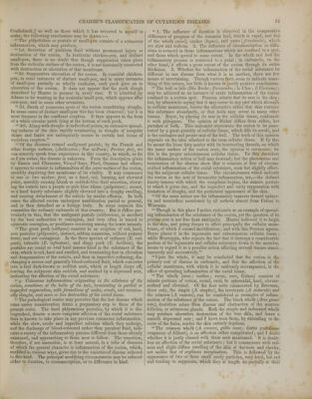
![Cruikshank,] as well as those which it has occurred to myself to make, the following conclusions may be drawn:— The phlyctidium or pustule of small-pox consists of a cutaneous inflammation, which may produce, 1st. Secretion of puriform fluid without permanent injury or destruction of the corion. In lenticular chicken-pox, and distinct small-pox, there is no doubt that though suppuration takes place from the cuticular surface of the corion, it is not necessarily connected with destruction or ulceration of that membrane. 2d. Suppurative ulceration of the corion. In conoidal chicken- pox, in some instances of distinct small-pox, and in many instances of small-pox partially or wholly confluent, each pock goes on to ulceration of the corion. It does not appear that the pock slough described by Hunter is present in every case. It is admitted by Adams to be wanting in the vesicular small-pox, which appears after cow-pox, and in some other occasions. 3d. Death of numerous spots of the corion constituting sloughs. In some cases of distinct small-pox this has been observed ; but it is most frequent in the confluent eruption. It then appears in the form of a white circular patch lying at the bottom of each pock. 4th. Along with sloughs at individual points, an extensive spread- ing redness of the skin rapidly terminating in sloughs of irregular shape and limits not unfrequently occurs in certain bad forms of variolous eruption. Of the diseases termed malignant jmstule, by the French and other foreign authors, (Anthracion; Nar al-Parsi; Persian fire), we. can scarcely speak from experience in this country, in which, so far as I am aware, the disease is unknown. From the description given by Enaux and Chaussier, Vicq-d'Azyr, Pinel, Ozanam and others, it appears to consist in inflammation of the outer surface of the corion, speedily depriving that membrane of its vitality. It may commence in one or two modes; first, as a hard, red, burning, not elevated point, speedily causing bluish or reddish-blue fluid secretion, elevat- ing the cuticle into a purple or pale blue blister (phlyctcena); second, ' as a hard knotty substance slightly elevated into a doughy swelling, and causing detachment of the cuticle by similar effusion. In both cases the affected corion undergoes mortification partial or general, and is then detached as a foreign body. In some respects this resembles the ordinary carbuncle of this country. But it differs par- ticularly in this, that the malignant pustule {anthracion), is ascribed by the best authorities to contagion, and very often is traced to epizootic contagion, or pestilence occurring among the lower animals. The great pock (ecthyma) consists in an eruption of red, hard, sore pustules (phlyzacia), distinct, seldom numerous, without primary fever, and not contagious. In the three species of ordinary (E. vul- gare), infantile (E. infantum), and dingy pock (E. luridum), the pustules are round or oval hard masses fixed in the substance of the skin, which is red, hard and swelled, and terminating first in elevation and desquamation of the cuticle, and then in imperfect softening, dis- charging a serous and generally blood-coloured fluid, which concretes into a foul dark-brown or reddish scab, which at length drops off, leaving the subjacent skin reddish, and marked by a depressed scar, indicating the affection of the corial substance. 11 g. Cutaneous inflammations originating in the substance of the corion, sometimes at the bulbs of the hair, terminating in partial or imperfect suppuration, with formations of scales, crusts, and occasion- ally sloughs, and more or less destruction of the corial tissue. The pathological reader may perceive that the last disease which came under consideration forms a preparatory step to those of the present order. The hard phlyzacious pustules, by which it is dis- tinguished, denote a more complete affection of the corial substance than is known to take place in any previous cutaneous inflammation; while the slow, crude and imperfect solution which they undergo, and the discharge of blood-coloured rather than purulent fluid, indi- cates a variety of the inflammatory process different from those already examined, and approaching to those now to follow. The transition, therefore, if not insensible, is at least natural, to a tribe of diseases of which the general character is inflammation of the corion, which, modified in various ways, gives rise to the varieties of disease referred to this kind. The principal modifying circumstances maybe referred either to duration, to circumscription, or to difference in kind. 1. The influence of duration is observed in the comparative difference of progress of the common boil, which is rapid, and that of the whelk {acne), canker {lupus), and yaws (frambcesia), which are slow and tedious. 2. The influence of circumscription or diffu- sions is evinced in those inflammations which are confined to a spot, and those which spread to some extent. In the whelk and boil the inflammatory process is restricted to a point; in carbuncle, on the other hand, it affects a great extent of the corion through its entire thickness. 3. Whether the inflammation of the corial substance be different in one disease from what it is in another, there are few means of ascertaining. Though various facts seem to indicate some- thing of this nature, too little is known to justify positive conclusions. The boil or bile (Die Beule; Furunculus; le Clou ; il Ciccione); may be adduced as an instance of acute inflammation of the corion confined to a certain spot. Pearson admits that its seat is the skin; but, by afterwards saying that it may occur in any part which abounds in cellular membrane, leaves the alternative either that skin contains this substance abundantly, or that boils may occur in many other tissues. Boyer, by placing its seat in the cellular tissue, confounds it with phlegmon. The opinion of Bichat differs from either, but partakes of both. This anatomist represents the corion to be pene- trated by a great quantity of cellular tissue, which fills its areola, and is the exclusive and proper seat of the boil. The truth of this opinion depends on the idea attached to the term cellular tissue. If by this be meant the loose fatty matter with its intersecting threads, on which the inner surface of the corion rests, the opinion is erroneous; for this is the proper subcutaneous cellular tissue. To this doubtless the inflammatory action of boil may descend; but the phenomena and termination of the disease show that it consists at first of circum- scribed inflammation of the corial substance, soon but slightly affect- ing the subjacent cellular tissue. The circumstances which indicate the corion as the seat of furuncular inflammation, are,—the defined knotty tumour with which the complaint begins, the minute pustule to which it gives rise, and the imperfect and tardy suppuration with formation of sloughs, and the perforated appearance of the skin. Of the same nature are the inflammatory tumours termed epinyc- tis and terminthus mentioned by all authors almost from Celsus to Wiseman. Though in this place I notice carbuncle as an example of spread- ing inflammation of the substance of the corion, yet the question of its precise seat is not free from ambiguity. Hunter believed it to begin in the skin, and going deeper to affect principally the cellular mem- brane, of which it caused mortification ; and with this Pearson agrees. Boyer places it in the teguments and subcutaneous cellular tissue ; while Monteggia, who repeats the fact that it destroys a considerable portion of the teguments and cellular substance down to the muscles, seems to regard it as a peculiar action affecting seAeral tissues simul- taneously and successively. Upon the whole, it may be concluded that the corion is the primary seat of disease in carbuncle, and that the affection of the cellular membrane, with which it is uniformly accompanied, is the effect of spreading inflammation of the corial tissue. The whelk (acne; ionthos; varus, vari, Celsus) consists of minute portions of corion, round, oval, ttr spheroidal, hard, circum- scribed and elevated. Of the four sorts enumerated by Bateman, three only, the simple (A. simplex), the inveterate (A. indurata) and the crimson (A. rosacea), can be considered as examples of inflam- mation of the substance of the corion. The black whelk (Acne punc- tata), doubtless arises from disease and obstruction of the mucous follicles, or sebaceous glands. Both the simple and indurated whelk may produce ulcerative destruction of the true skin, and leave a smooth depressed scar; and I have seen them, by extending to the roots of the hairs, render the skin entirely depilous. The crimson whelk (A. rosacea, gutta rosea; dartre pustuleuse couperose of Alibert), is an affection rather complicated; and I doubt whether it is justly classed with those now mentioned. It is doubt- less an affection of the corial substance ; but it commences with red- ness and slight diffuse swelling of the skin of the nose and cheeks, not unlike that of erythema marginatum. This is followed by the appearance of two or three small seedy particles, very hard, but red and tending to suppurate, which they at length do partially at their](https://iiif.wellcomecollection.org/image/b21149495_0055.jp2/full/800%2C/0/default.jpg)