A theoretical and practical treatise on the diseases of the skin / by P. Rayer.
- Pierre François Olive Rayer
- Date:
- 1845
Licence: Public Domain Mark
Credit: A theoretical and practical treatise on the diseases of the skin / by P. Rayer. Source: Wellcome Collection.
Provider: This material has been provided by the National Library of Medicine (U.S.), through the Medical Heritage Library. The original may be consulted at the National Library of Medicine (U.S.)
58/582
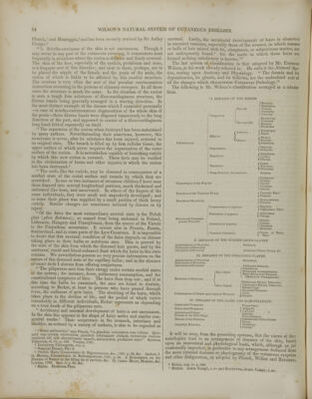
![Wll Ml RAL SYSTEM OF CUTANEOUS DISEA5 ... by S skin is not uncommon. Though il . n is delicate and thinly co jrelids, prolabium and nose, i r; and next to these, perhaps, arc to and the penis of the male, the i> liable to he affected by this morhid structure. often the seat of that peculiar carcinomatous irringinthi if chimney sweepers. In all these is much the same. In the situation of the corion Q a tough linn substance of fibro-cartilaginous structure, the bands being generally arranged in a waving direction. In tincl example of the disease which I examined personally ireinomatous degeneration of the whole skin of fibrous hands were disposed transversely to the long direction of the part, and appeared to consist of a fibro-cartilaginous long band folded repeatedly on itself. The reparation of the corion when destroyed has been maintained • J many authors. Notwithstanding their assertions, however, this membrane is never, after its substance has been injured, restored to ginal stale. The breach is filled up by firm cellular tissue, the upper surface of which never acquires the organization of the outer surface of the corion. It is nevertheless capable of furnishing cuticle by which this new corion is covered. These facts may be verified in the cicatrization of burns and other injuries in which the corion bas been destroyed.4 The nails, like the cuticle, may be diseased in consequence of a morbid slate of the corial surface and vessels by which they are nourished. In one or two instances of strumous children I have seen them fissured into several longitudinal portions, much thickened and indurated like horn, and incurvated. In others of the fingers of the same individuals, they were small and imperfectly developed ; and in some their place was supplied by a small portion of thick horny cuticle. Similar changes arc sometimes induced by disease or by injury. Of the fairs the most extraordinary morbid state is the Polish plait (plica Polonica); so named from being endemial in Poland, Lithuania, Hungary and Transylvania, from the source of the Vistula to the Carpathian mountains. It occurs also in Prussia, Russia, Switzerland, and in some parts of the Low Countries. It is impossible to doubt that this anormal condition of the hairs depends on disease taking place in their bulbs or nutritious sacs. This is proved by te of the skin from which the diseased hair grows, and by the unctuous, viscid and blood-coloured fluid which the hairs in this state contain. We nevertheless possess no very precise information on the nature of this diseased state of the capillary bulbs ; and in the absence \act facts I abstain from offering conjectures. The piliparous sacs lose their energy under certain morbid states ot the system ; for instance, fever, pulmonary consumption, and the constitutional symptoms of lues. The hairs then drop out; and if at •Ins time the bulbs be examined, the sacs are found to contain, according to Bichat, at least in persons who have passed through lever, the rudiment of new hairs. The shedding of the hairs, which takes place in the decline of life, and the period of which varies remarkably in different individuals, Bichat represents as depending on a total death of the piliparous sacs. Accidental and anormal development of hairs is not uncommon. In the skin this appears in the shape of hairy moles and similar con- genital marks.5 Their occurrence in the stomach, intestines and bladder, as noticed by a variety of authors, is also to be regarded as Sedes meliceridis, says Plenck, in glandula subentanea esse videtur. Quic- qu.d ergo porum excretonum glandule subcutane* obdurat, contentum sneenm •rSp,SSrf mT?i e,US a^rpt,£nem imPedit' nieliceridem producere valet. Systema rumorum, cl. vtt. p. 153. Viennse, 1767. 4 Intituzione Chirurgiche, vol. ii! * Surgical Essa I ahn Commentatio de Regeneratione, &c, 1787, p. 23, &c. Andres J d. Murrav, Commentatio de Redinte«ratione I7a- „\n » tv ,■ , Hailer. Elementa Phys. anormal. Lastly, the accidental development of hairs is observe,] in encysted tumours, especially those of the ovaries, in which masses or balls of hair mixed with I idipocirous matter, arc not unfrequently found. On tl in which these hairs are formed nothing satisfactory is known The last system of classification is thai adopted by Mr. Erasmus Wilson, in his work already referred to. He calls il the Natural Sys- Sting upon Anatomy and Physiology. The dermis and its dependencies, its glands, and its follicles, are the undoubted seat of all the changes which characterize Cutaneous Pathology. The following is Mr. Wilson's classification arranged in a tabular form. •I. DISEASES RMIS. ( Congestive ( Specific I I I Non-specific f Asthen (.Sthenic f R'.il i ' atina. -; Variola. I Varicella. [Van (Erysipelas. J Urticaria. c.la. Iieraa. V Pemphigus. ( Rupia. ( Herpes, Eczema. (.Sudamiaa. *w»*« {]'; _ . . f Strophulus. Depositee . J L.ichi n. (_ Prurigo. i Lepra. < Psoriasis. (.Pityriasis. Squamous From Parasitic An.malcules Hypertrophy of the Papilla; Scabies. (Ichthyosis. Tylosis. ■J Ciavus. 1 .in acse. I t'lunim. Disorders of the Vascular Tissue < Vascular Narvi. ( Purpura. Disordered Sensibility 5 Hyperesthesia. ( Pruritus. /Augmentation of pigment Diminution of pigment . . <, Nigritiee. ( Pigmentary Na i Disordered Chromato- genous Function . Alteration of pigment Chemical Coloration f Alhinismus. X Vitiligo. fF.phelis. I Lentigo. Chloasma. Melai >, Oxyde of Silver II. DISEASES OF THE SUDORIPAROUS GLANDS. Augmentation of Secretion Sudatoria. .mi of Secretion Alteration of Secretion Abnormal Odour, Colour, &e. III. DISEASES OF THE SEBACEOUS GLANDS. Augmentation of Secretion Stearrhcea. Diminution of Secretion Alteration of Secretion Ichthyosis Sebacca. fComedones. /Duct Open Retention of Secretion . . / VDuct Closed . Inflammation of Glands and adjacent Textures J Sebaceous Accumulations. 1 Small Sebaceous Tumours, ( {Molluscum Contagiosum.) f Sebaceous Miliary Tubercles. J Calcareous Miliary 1 ; Serous Cysts. led Tumours. ( Acne. ( Sycosis. IV. DISEASES OF THE HAIRS AND HAIR-FOLLK Augmented Formation Pilous Nsevi. Diminished Formation J Alopecia. .... ,~ , ( Cah < „ Alteratton of Colour Disease of the Hair-Pulps Plica Poloni, Disease of the Follicles 5 Inflarnmatio Folliculorum. I Favns. Abnormal Direction 5 Trichiasis. ( Felting.'' It will be seen, from the preceding systems, that the views of der- matologists tend to an arrangement of diseases of the skin based upon an anatomical and physiological basis, which, although' as vet confessedly imperfect, is preferable to any arrangement deduced from the more external features or physiognomy of the cutaneous emotion and other disfiguration, as adopted by Plenck, Willan and Bateman, « Bichat, torn. iv. p. 828. ' Meckel. Journ. Compl., t. iv. and Brkhe'.eau, Journ. Compl., t. xv](https://iiif.wellcomecollection.org/image/b21149495_0058.jp2/full/800%2C/0/default.jpg)