The American text-book of operative dentistry / in contributions by eminent authorities.
- Edward Cameron Kirk
- Date:
- [1905]
Licence: Public Domain Mark
Credit: The American text-book of operative dentistry / in contributions by eminent authorities. Source: Wellcome Collection.
Provider: This material has been provided by the Augustus C. Long Health Sciences Library at Columbia University and Columbia University Libraries/Information Services, through the Medical Heritage Library. The original may be consulted at the the Augustus C. Long Health Sciences Library at Columbia University and Columbia University.
24/916 page 18
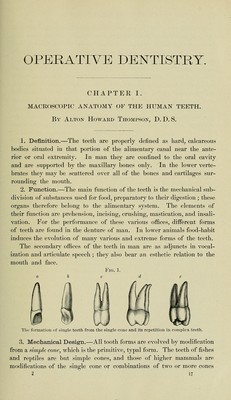
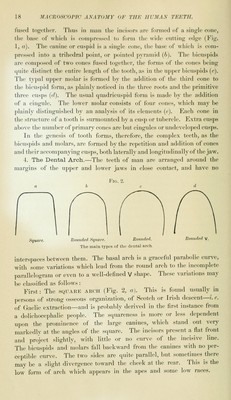
![fused together. Tluis in mkiii the incisors arc formed of a single cone, the base of whieli is compressed to form the wicK- cutting edge (Fig. 1, a). The canine or cuspid is a singk' cone, the base of which is com- pressed into a trihedral point, or jxtinted jnramid (6). The bicuspids are composed of two cones fused together, the forms of the cones being <|uite distinct the entire length of the tooth, as in the upper bicus])ids (c). The tvi)al upper molar is fornu'd by the addition of the third cone to the bicuspid form, as |)hiiMly noticed in the three roots and the primitive three cusps {d). The usual (juadricuspid form is made by the addition of a cingule. The lower molar consists of four cones, which may be j)lainly distinguished i)y an analysis of its elements (e). Each cone in the structure of a tooth is surmounted by a cusp or tubercle. Extra cusps above the number of primary cones are but cingules or undeveloped cusps. In the genesis of tooth forms, therefore, the complex teeth, as the bicuspids and molars, are formed by the repetition and addition of cones and their accompanying cusps, both laterally and longitudinally of the jaw. 4. The Dental Arch.—The teeth of man are arranged around the margins of the upper and lower jaws in close contact, and have no Fig. 2. Square. Rounded Square. Rounded. Rounded V. The main types of the dental arch. interspaces between them. The basal arch is a graceful parabolic curve, with some variations which lead from the round arch to the incomplete parallelogram or even to a well-defined V shape. These variations may be classified as follows: First: The square arch (Fig. 2, a). This is found usually in persons of strong osseous organization, of Scotch or Irish descent—/. e. of Gaelic extraction—and is probably derived in the first instance from a dolichocephalic people. The squareness is more or less dependent upon the prominence of the large canines, which stand out very markedly at the angles of the square. The incisors present a flat front and project slightly, with little or no curve of the incisive line. The bicuspids and molars fall backward from the canines with no per- ceptible curve. The two sides are quite parallel, but sometimes there mav be a slight divergence toAvard the cheek at the rear. This is the low form of arch which appears in the apes and some low races.](https://iiif.wellcomecollection.org/image/b21216617_0024.jp2/full/800%2C/0/default.jpg)