The American text-book of operative dentistry / in contributions by eminent authorities.
- Edward Cameron Kirk
- Date:
- [1905]
Licence: Public Domain Mark
Credit: The American text-book of operative dentistry / in contributions by eminent authorities. Source: Wellcome Collection.
Provider: This material has been provided by the Augustus C. Long Health Sciences Library at Columbia University and Columbia University Libraries/Information Services, through the Medical Heritage Library. The original may be consulted at the the Augustus C. Long Health Sciences Library at Columbia University and Columbia University.
32/916 page 26
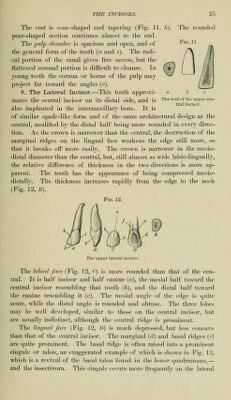
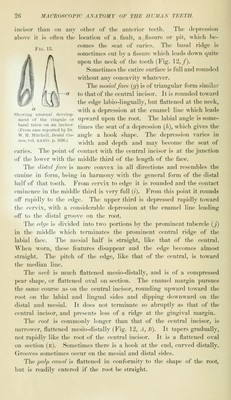
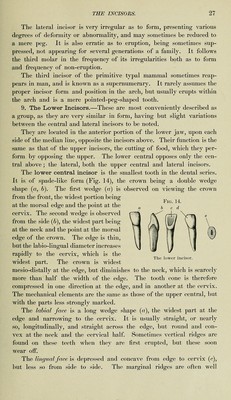
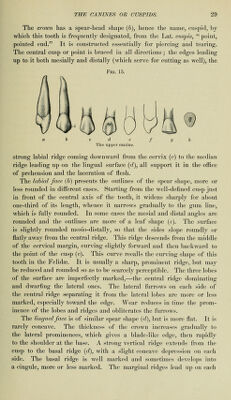
![incisor than <m any otlu-r of tlic anterior t«'('tli. The depression al)ove it is ofton tlie location of a fault, a fissun; or |)it, which hc- conies the seat of caries. The basal ridge is sometimes cut hv a tissun- which leads down quite n]>on the neck of the tooth (Fig. 1-,/). Sometimes the entire surface is full and rounded without any concavity whatever. The mesial face (g) is of triangular form similar a to that of the central incisor. It is rounded toward the edge lahio-lingually, but flattened at the neck, ** with a depression at the enamel line which leads Showing unusual develop- *^ mi i i • i i • ment of the cinguie or Upward upon the root. 1 he labial angle is some- basal talon on an incisor, ^jj^^^.^ ^j^^. ^^,^^ ^^^-^ depression (/(), wllich givCS the (From case reported by Dr. ^ . . , w. H. Mitchell, Dattai Cos- angle a hook shape. The depression varies in «,o.,voi.xxxiv.p.i036.) ^^.j^^jj^ ,^j^^j ^l^^^^^j^ .^j^^l j^^,j^. become the seat of caries. The point of contact with the central incisor is at the junction of the lower with the middle third of the length of the face. The dktal face is more convex in all directions and resembles the canine in form, being in harmony with the general form of the distal half of that tooth. From cervix to edge it is rounded and the contact eminence in the middle third is very full (/). From this point it rounds off rapidly to the edge. The upper third is depressed rapidly toward the cervix, with a considerable depression at the enamel line leading off to the distal groove on the root. The edge is divided into two portions by the prominent tubercle (_/) in the middle which terminates the prominent central ridge of the labial face. The mesial half is straight, like that of the central. When worn, these features disappear and the edge becomes almost straight. The pitch of the edge, like that of the central, is toward the median line. The neck is much flattened mesio-distally, and is of a compressed pear shape, or flattened oval on section. The enamel margin pursues the same course as on the central incisor, rounding upward toward the root on the labial and lingual sides and dipping downward on the distal and mesial. It does not terminate so abruptly as that of the central incisor, and presents less of a ridge at the gingival margin. The root is commonly longer than that of the central incisor, is narrower, flattened mesio-distally (Fig, 12, A, B). It tapers gradually, not rapidly like the root of the central incisor. It is a flattened oval on section (e). Sometimes there is a hook at the end, curved distally. Grooves sometimes occur on the mesial and distal sides. The pulp canal is flattened in conformity to the shape of the root, but is readily entered if the root be straight.](https://iiif.wellcomecollection.org/image/b21216617_0032.jp2/full/800%2C/0/default.jpg)