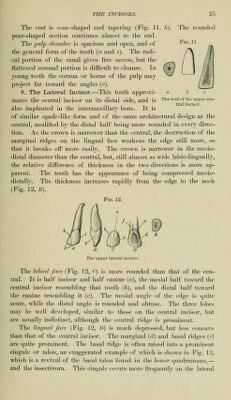
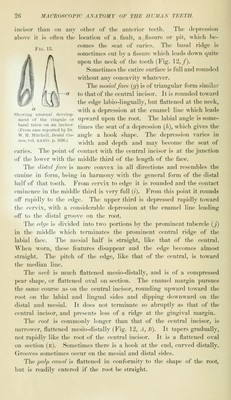
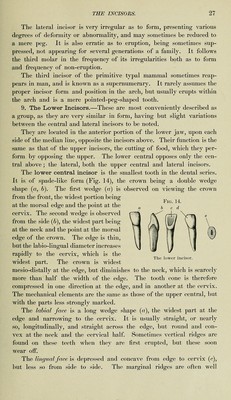
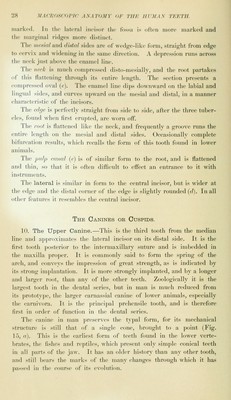
The American text-book of operative dentistry / in contributions by eminent authorities.
- Edward Cameron Kirk
- Date:
- [1905]
Licence: Public Domain Mark
Credit: The American text-book of operative dentistry / in contributions by eminent authorities. Source: Wellcome Collection.
Provider: This material has been provided by the Augustus C. Long Health Sciences Library at Columbia University and Columbia University Libraries/Information Services, through the Medical Heritage Library. The original may be consulted at the the Augustus C. Long Health Sciences Library at Columbia University and Columbia University.
36/916 page 30
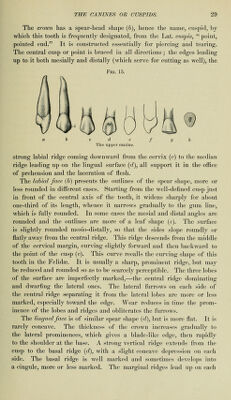
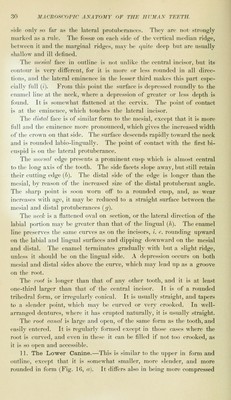
![side only so far a> the lateral jn-otiilHTaiico. Tlicy arc not strongly marked as a rule. The fosste on each side of the vertical median ridge, between it and the marginal ridges, may he <|uite deep hut are usually shallow and ill defined. The mesial face in outline is not unlike the central ineisor, but its contour is very diU'erent, for it is more or less rounded in all direc- tions, and the lateral eminence in the lesser third makes this part espe- cially full (i). From this j)oint the surface is depressed roundly to the enamel line at the neck, where a depression of greater or less depth is lound. It is someNvhat flattened at the cervix. The point of contact is at the eminence, which touches the lateral incisor. The (Jisfdl face is of similar form to the mesial, exce])t that it is more full and the eminence more pronounced, which gives the increased width of the crown on that side. The surface descends rapidly toward the neck and is rounded labio-lingually. The point of contact with the first bi- cuspid is on the lateral protuberance. The morsal edge presents a prominent cusp which is almost central to the long axis of the tooth. The side facets slope away, but still retain their cutting edge (6). The distal side of the edge is longer than the mesial, by reason of the increased size of the distal protuberant angle. The sharp point is soon worn off to a rounded cusp, and, as wear increases with age, it may be reduced to a straight surface between the mesial and distal protuberances {</). The neck is a flattened oval on section, or the lateral direction of the labial portion may be greater than that of the lingual (h). The enamel line preserves the same curves as on the incisors, /. e. rounding upward on the labial and lingual surfaces and dipping downward on the mesial and distal. The enamel terminates gradually with but a slight ridge, unless it should be on the lingual side. A depression occurs on both mesial and distal sides above the curve, which may lead up as a groove on the root. The root is longer than that of any other tooth, and it is at least one-third larger than that of the central incisor. It is of a rounded trihedral form, or irregularly conical. It is usually straight, and tapers to a slender point, which may be curved or very crooked. In well- arranged dentures, where it has erupted naturally, it is usually straight. The root canal is large and open, of the same form as the tooth, and easily entered. It is regularly formed excejit in those cases where the root is curved, and even in these it can be filled if not too crooked, as it is so open and accessible. 11. The Lower Canine.—This is similar to the u])per in form and outline, except that it is somewhat smaller, more slender, and more rounded in form (Fig. 16, (i). It differs also in being more compressed](https://iiif.wellcomecollection.org/image/b21216617_0036.jp2/full/800%2C/0/default.jpg)