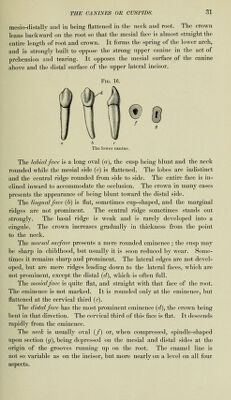
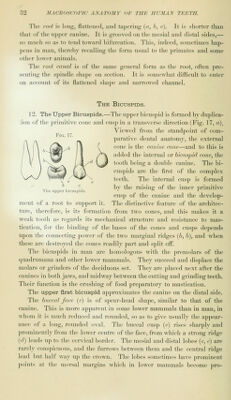
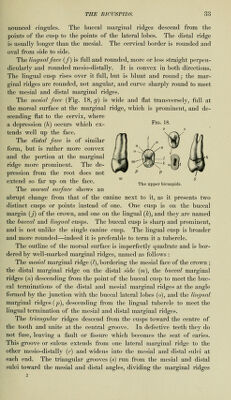
The American text-book of operative dentistry / in contributions by eminent authorities.
- Edward Cameron Kirk
- Date:
- [1905]
Licence: Public Domain Mark
Credit: The American text-book of operative dentistry / in contributions by eminent authorities. Source: Wellcome Collection.
Provider: This material has been provided by the Augustus C. Long Health Sciences Library at Columbia University and Columbia University Libraries/Information Services, through the Medical Heritage Library. The original may be consulted at the the Augustus C. Long Health Sciences Library at Columbia University and Columbia University.
40/916 page 34
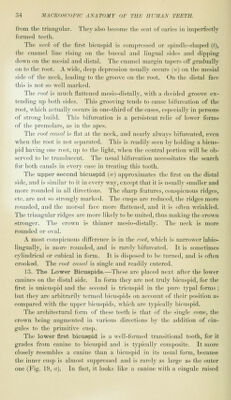
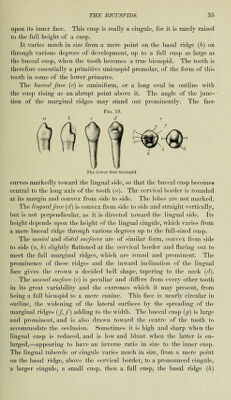
![from the trianjjuhir. Tlicy also Itccoinc the scat of caries in imperfectly formed tooth. Tho )i(rk of tlic first bicuspid is conii)rcssc(l or s])in(no-shaped (t), the enamel line risin*:; on the hnecal and lingual sides and dipping down on the mesial and distal. The enamel margin tapers otf gradually on to the root. A wide, deep de})rossion usually occurs ((/) on tho mesial side of the neck, leading to the groove on the root. On the distal face this is not so well marked. Tho root is much Hattonod mesio-tlistally, with a decided groove ex- tending up both sides. This grooving tends to cause bifurcation of the root, which actually occurs in one-third of the cases, especially in persons of strong build. This bifurcation is a persistent relic of lower forms of tho premolars, as in the apes. The root canal is flat at the neck, and nearly always bifurcated, even when the root is not separated. This is readily seen by holding a bicus- pid having one root, up to the light, when tho central portion will l)e ob- served to be translucent. Tho usual bifurcation necessitates the search for both canals in every case in treating this tooth. The upper second bicuspid {ic) approximates the first on the distal side, and is similar to it in every way, except that it is usually smaller and more rounded in all directions. Tho sharp features, conspicuous ridges, etc. are not so strongly marked. The cusps are reduced, the ridges more rounded, and the morsal face more flattened, and it is often wrinkled. The triangular ridges are more likely to be united, thus making the crown stronger. The crown is thinner mosio-distally. The neck is more rounded or oval. A most conspicuous difference is in the 7'oot, which is narrower labio- lingually, is more rounded, and is rarely bifurcated. It is sometimes cylindrical or cubical in form. It is disposed to be turned, and is often crooked. The 7-oot canal is sinorle and readilv entered. 13. The Lower Bicuspids.—Those are placed next after the lower canines on the distal side. In form they are not truly bicuspid, for the first is unicuspid and the second is tricuspid in the pure typal forms; but they are arbitrarily termed bicuspids on account of their position as compared with the u])])er bicuspids, which are typically bicuspid. The architectural form of these teeth is that of the single cone, the crown being augmented in various directions by the addition of cin- gules to the primitive cusp. The lower first bicuspid is a well-formed transitional tooth, for it grades from canine to bicuspid and is typically composite. It more closely resembles a canine than a bicuspid in its usual form, because the inner cusp is almost suppressed and is rarely as large as the outer one (Fig. 19, «). In fact, it looks like a canine with a cingule raised](https://iiif.wellcomecollection.org/image/b21216617_0040.jp2/full/800%2C/0/default.jpg)