The American text-book of operative dentistry / in contributions by eminent authorities.
- Edward Cameron Kirk
- Date:
- [1905]
Licence: Public Domain Mark
Credit: The American text-book of operative dentistry / in contributions by eminent authorities. Source: Wellcome Collection.
Provider: This material has been provided by the Augustus C. Long Health Sciences Library at Columbia University and Columbia University Libraries/Information Services, through the Medical Heritage Library. The original may be consulted at the the Augustus C. Long Health Sciences Library at Columbia University and Columbia University.
48/916 page 42
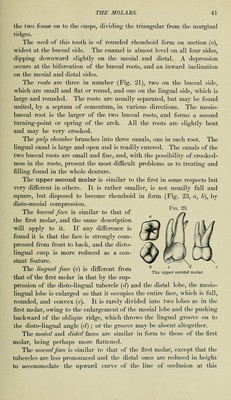
![|)oiiit. The (listo-linffual oiiifrulc is snialltT than that upon the first molar, and is often hardy marked. This throws the oblique ridge more to the distal side and enlart^es tlie mesial f(»ssa. The various grooves are the same as on the Hrst molar, except that one, the lingual, may be lost. The neck is less regular in outline than that of the Hrst molar, as the crown varies so mueii in shape. It is more flattened mesio-distally and ilepressed toward the roots. The roots are the same in number and general form as in the first molar, but spread less and are more irregular in form. They may con- verge or be crooked, or may be fused together. This makes the pulp canals more difficult to treat. Sometimes the three roots are completely fused, as in the third molar, and the canals may coalesce ; or the canals of the two buccal roots may run into one. The irregularity and uncer- tainty of the form of the roots make this tooth difficult to deal with in treatinc; its root canals. 10. The Lower Molars.—The lower first molar ajiproximates the lower second bicuspid on its distal side. It is the first of the true grind- ers of the lower jaw and the largest tooth in the dental series. Unlike the upper molars the transverse diameter is less than the mesio-distal. The greater width is found across the base of the disto-buccal tubercle. The crown is s(juare or trapezoidal in form, de])ending on the size of the fifth tubercle. Being quinquituberculate, the crown is broadened by the multicuspid grinding face. The buccal face is inclined toward the centre of the tooth, for its morsal half, to accommodate the occluding teeth. Architecturally, the tooth is formed of four cones (Fig. 24, A), and Architectural diagram. g B The lower tirst molar. mav be roughly divided into four quarters. There are four primitive cones with their tubercles and one cingule in the structure.](https://iiif.wellcomecollection.org/image/b21216617_0048.jp2/full/800%2C/0/default.jpg)