The American text-book of operative dentistry / in contributions by eminent authorities.
- Edward Cameron Kirk
- Date:
- [1905]
Licence: Public Domain Mark
Credit: The American text-book of operative dentistry / in contributions by eminent authorities. Source: Wellcome Collection.
Provider: This material has been provided by the Augustus C. Long Health Sciences Library at Columbia University and Columbia University Libraries/Information Services, through the Medical Heritage Library. The original may be consulted at the the Augustus C. Long Health Sciences Library at Columbia University and Columbia University.
50/916 page 44
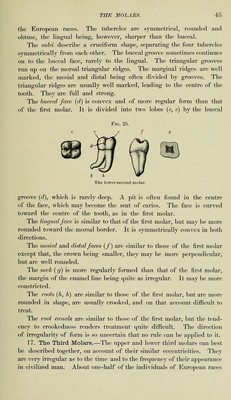
![slmrj) autrlf with the niorsal surface, wliicli is siirmoiiiitcd with two tiilxTcU's. Sometimes, l)iit rarely, the lintrnal ^move jiasses over on to tliis face. The iiirsid/ and disfa/ fdcr.^ (n) are wide and flattened transversely, hut convex vertically. They are trajnzoidal in outline, the niorsal border bein^ longer. The cervical border is more convex, and dips toward the neck of the tooth. The neck (f) is very regidar in outline and contour. It is approxi- mately sijuare with all four sides depressed in the centres. The mesial and distal are depressed at the origins of the grooves leading down upon the roots; the lingual and buccal are depressed at the bifurca- tion of the roots, the depression, which is w'ide and deep, extending up on to the neck, especially upon the buccal side. The enamel line is (juite irregular, dipping down on the lingual and buccal, and leading well up on the mesial and distal sides. The rootx are two in number, placed with their longer diameter trans- versely to the jaw. They are wide bucco-lingually, and flat and narrow disto-mesially, being situated distally and mcsially to the crown. The ])osterior is formed of the two posterior cones, and the anterior of the two anterior cones (A). This is plainly shown in the formation of the roots, which are grooved botli distally and mesially, and in the tendency to bifurcation, which sometimes actually occurs. They divide close to the crown, so that the grooves of bifurcation extend well up on the neck. The distal root is thicker and more rounded than the mesial, the latter being more flattened, with the grooves deeper, and it is more often bifurcated. Both are deflected from the median line. The root canal is shaped like the roots, with two main branches. The distal branch is the larger, being round and ojien, as the root is more rounded. The mesial branch is flat and spindle-shaped, being diflicult to enter, and usually having two sub-branches following the buccal and lingual divisions of the root. These sub-branches are small and hair- like aud troublesome to enter. The lo-wer second molar (Fig. 25) differs from the first in many respects. It is of the same general form, but is more quadrangular, as it has but four tubercles. It is more rounded and symmetrical than the first, the four cones and four primitive tubercles being well marked. The absence of the fifth tubercle leads to most of the differences between the second and the first molar. The morsal face (c) has but four tubercles, one at each corner of the face, differing from that of the first molar, which has five. The fifth tubercle rarely appears in the higher races of mankind, but is some- times found in the low and savage races, and occurs regularlv in the apes. It is n(^t uncommon in the negro, but is absent as a rule in](https://iiif.wellcomecollection.org/image/b21216617_0050.jp2/full/800%2C/0/default.jpg)