The American text-book of operative dentistry / in contributions by eminent authorities.
- Edward Cameron Kirk
- Date:
- [1905]
Licence: Public Domain Mark
Credit: The American text-book of operative dentistry / in contributions by eminent authorities. Source: Wellcome Collection.
Provider: This material has been provided by the Augustus C. Long Health Sciences Library at Columbia University and Columbia University Libraries/Information Services, through the Medical Heritage Library. The original may be consulted at the the Augustus C. Long Health Sciences Library at Columbia University and Columbia University.
54/916 page 48
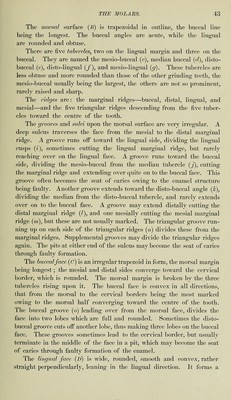
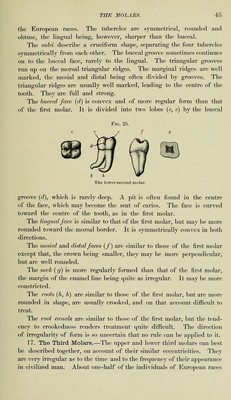
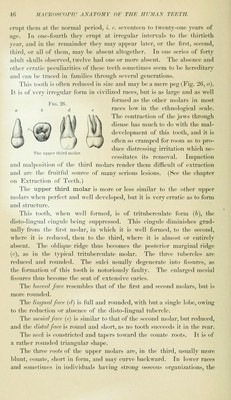
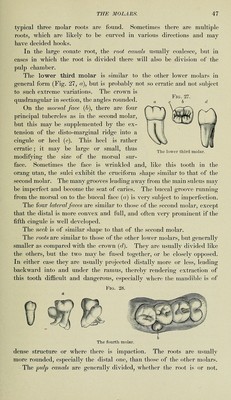
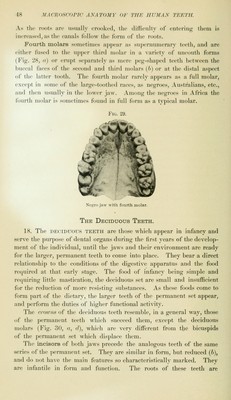
![As tlic nxtts arc usually crooked, the dilticiilty of onteriiitj:; them is increased, as the canals follow the form of the roots. Fourth molars sometimes a|)|»ear as superiiumerarv teeth, and are either fused to the U])]ter thii'd molar in a variety of uncouth forms (Fi^. JS, (t) or eru[)t sej)arately as mere |)e<;-sliaj)ed teeth between the buccal faces of the second and third molars (J)) or at tlio distal aspect of the latter t(»oth. The fourth molar rarely appears as a full molar, except in some of the lar<;e-toothed races, as neg;roes, Australians, etc., and then usually in the lower jaw. Among the negroes in Africa the fourth molar is sometimes found in full form as a typical molar. Fig. 29. Negro jaw with fourth molar. The Deciduous Teeth. 18. The DECIDUOUS teeth are those which appear in infancy and serve the purpose of dental organs during the first years of the develop- ment of the individual, until the jaws and their environment are ready for the larger, permanent teeth to come into place. They bear a direct relationship to the conditions of the digestive apparatus and the food required at that early stage. The food of infancy being simple and requiring little mastication, the deciduous set are small and insufficient for the reduction of more resisting substances. As these foods come to form part of the dietary, the larger teeth of the permanent set appear, and perform the duties of higher functional activity. The croicn.s of the deciduous teeth resemble, in a general way, those of the permanent teeth which succeed them, except the deciduous molars (Fig. 30, a, d), which are very different from the bicuspids of the permanent set which displace them. The incisors of both jaws precede the analogous teeth of the same series of the ])ermanont set. They are similar in form, but reduced (6), and do not have the main features so characteristically marked. They are infantile in form and function. The roots of these teeth are](https://iiif.wellcomecollection.org/image/b21216617_0054.jp2/full/800%2C/0/default.jpg)