The drunkard's diseased appetite : what is it? if curable how? by miraculous agency or physical means -- which? / [J. Willett].
- Willett, J. (John), -1881
- Date:
- 1877
Licence: Public Domain Mark
Credit: The drunkard's diseased appetite : what is it? if curable how? by miraculous agency or physical means -- which? / [J. Willett]. Source: Wellcome Collection.
Provider: This material has been provided by the National Library of Medicine (U.S.), through the Medical Heritage Library. The original may be consulted at the National Library of Medicine (U.S.)
19/20
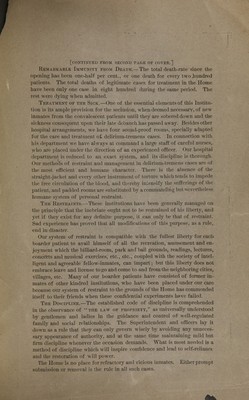
![[continued from second page of cover.] Remarkable Immunity from Death.—The total death-rate since the opening has been one-half per cent., or one death for every two hundred patients. The total deaths of legitimate cases for treatment in the Home have been only one case in eight hundred during the same period. The rest were dying when admitted. Treatment of the Sick.—One of the essential elements of this Institu- tion is its ample provision for the seclusion, when deemed necessary, of new inmates from the convalescent patients until they are sobered down and the sickness consequent upon their late debauch has passed away. Besides other hospital arrangements, we have four sound-proof rooms, specially adapted for the care and treatment of. delirium-tremens cases. In connection with his department we have always at command a large staff of careful nurses, who are placed under the direction of an experienced officer. Our hospital department is reduced to au exact system, and its discipline is thorough. Our methods of restraint and management in delirium-tremens cases are of the most efficient and humane character. There is the absence of the straight-jacket and every other instrument of torture which tends to impede the free circulation of the blood, and thereby intensify the sufferings of the patient, and padded rooms are substituted by a commanding but nevertheless humane system of personal restraint. The Restraints.—These institutions have been generally managed on the principle that the inebriate ought not to be restrained of his liberty, and yet if they exist for any definite purpose, it can only be that of restraint. Sad experience has proved that all modifications of this purpose, as a rule, end in disaster. Our system of restraint is compatible with the fullest liberty for each boarder patient to avail himself of all the recreation, amusement and en- joyment which the billiard-room, park and ball grounds, readings, lectures, concerts and musical exercises, etc., etc., coupled with the society of intel- ligent and agreeable fellow-inmates, can impart; but this liberty does not embrace leave and license to go and come to and from the neighboring cities, villages, etc. Many of our boarder patients have consisted of former in- mates of other kindred institutions, who have been placed under our care because our system of restraint to the grounds of the Home has commended itself to their friends when these confidential experiments have failed. The Discipline.—The established code of discipline is comprehended in the observance of the i.aav of propriety, as universally understood by gentlemen and ladies in the guidance and control of- well-regulated family and social relationships. The Superintendent and officers lay it down as a rule that they can only govern wisely by avoiding any unneces- sary, appearance of authority, and at the same time maintaining mild but firm discipline whenever the occasion demands. What is most needed is a method of discipline which will inspire confidence and lead to self-relianct and the restoration of w ill powrer. The Home is no place for refractory and vicious inmates. Either prompt submission or removal is the rule in all such cases.](https://iiif.wellcomecollection.org/image/b21164289_0019.jp2/full/800%2C/0/default.jpg)
 No text description is available for this image
 No text description is available for this image
 No text description is available for this image