The incidence and bacteriological characteristics of tuberculous infection in children / by Arthur Eastwood, M.D., and Fred Griffith, M.B. An enquiry, based on a series of autopsies, into the occurrence and distribution of turberculous infection in children, and its relation to the bovine and the human types of tubercle bacilli respectively / by A. Stanley Griffith, M.D.
- Date:
- 1914
Licence: Public Domain Mark
Credit: The incidence and bacteriological characteristics of tuberculous infection in children / by Arthur Eastwood, M.D., and Fred Griffith, M.B. An enquiry, based on a series of autopsies, into the occurrence and distribution of turberculous infection in children, and its relation to the bovine and the human types of tubercle bacilli respectively / by A. Stanley Griffith, M.D. Source: Wellcome Collection.
4/188
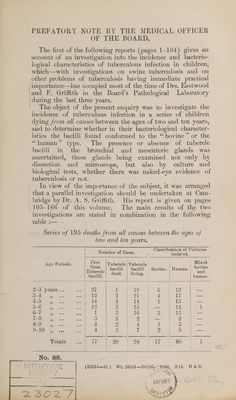
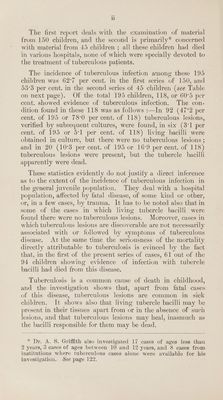
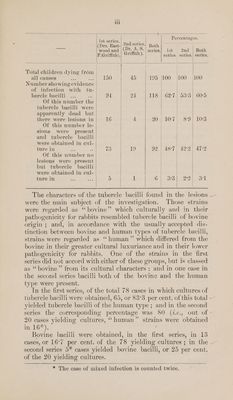
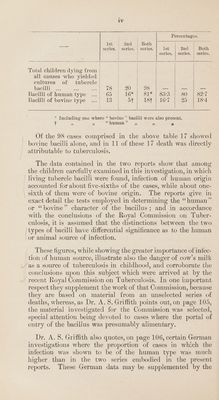
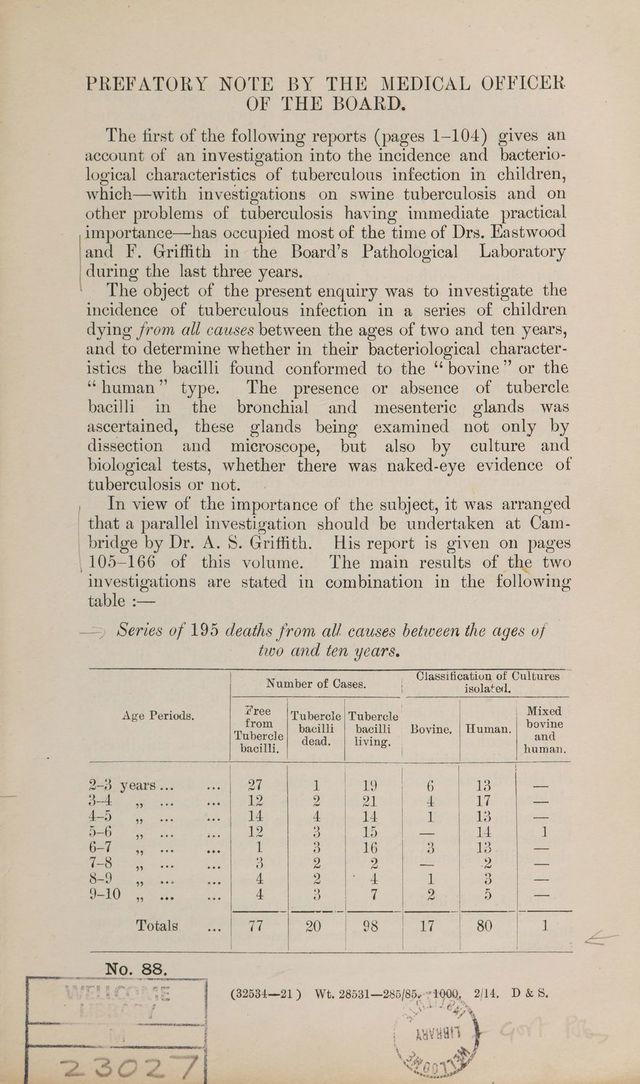
![u The first report deals with the examination of material from 150 children, and the second is primarily* concerned with material from 45 children ; all these children had died in various hospitals, none of which were specially devoted to the treatment of tuberculous patients. The incidence of tuberculous infection among these 195 children was 62°7 per cent. in the first series of 150, and 53°3 per cent. in the second series of 45 children (see Table on next page). Of the total 195 children, 118, or 60°5 per cent. showed evidence of tuberculous infection. The con- dition found in these 118 was as follows :—In 92 (47°2 per cent. of 195 or 78°0 per cent. of 118) tuberculous lesions, verified by subsequent cultures, were found, in six (8°1 per cent. of 195 or 5°] per cent. of 118) living bacilli were obtained in culture, but there were no tuberculous lesions ; and in 20 (10°3 per cent. of 195 or 16:9 per cent. of 118) tuberculous lesions were present, but the tubercle bacilli apparently were dead. These statistics evidently do not justify a direct inference as to the extent of the incidence of tuberculous infection in the general juvenile population. They deal with a hospital population, affected by fatal disease, of some kind or other, or, in a few cases, by trauma. It has to be noted also that in some of the cases in which living tubercle bacilli were found there were no tuberculous lesions. Moreover, cases in which tuberculous lesions are discoverable are not necessarily associated with or followed by symptoms of tuberculous disease. At the same time the seriousness of the mortality directly attributable to tuberculosis is evinced by the fact that, in the first of the present series of cases, 61 out of the 94 children showing evidence of infection with tubercle bacilli had died from this disease. Tuberculosis is a common cause of death in childhood, and the investigation shows that, apart from fatal cases of this disease, tuberculous lesions are common in sick children. It shows also that living tubercle bacilli may be present in their tissues apart from or in the absence of such lesions, and that tuberculous lesions may heal, inasmuch as the bacilli responsible for them may be dead. 2 Dx. A. S. Griffith also investigated 17 cases of ages less than 2 years, 3 cases of ages between 10 and 12 years, and 8 cases from institutions where tuberculous cases alone were available for his investigation. See page 122.](https://iiif.wellcomecollection.org/image/b29012971_0004.jp2/full/800%2C/0/default.jpg)