Aix-la-Chapelle (Aachen) as a health resort / by Alexander [and others].
- Alexander, Louis.
- Date:
- 1892
Licence: Public Domain Mark
Credit: Aix-la-Chapelle (Aachen) as a health resort / by Alexander [and others]. Source: Wellcome Collection.
Provider: This material has been provided by Royal College of Physicians, London. The original may be consulted at Royal College of Physicians, London.
18/340 page 6
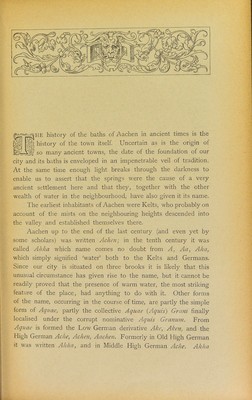
![means ‘flowing water’, but is not the simple translation of Aqua. In Fiench Aachen is called Ayx or Aix-la-Chapelle from the Pfalz- kapelle. The name of Aachen in Roman times has not come down to us. It was probably called Aquae with the distinctive term Grani. In earlier times it was thought that Granus was a brother of Nero and that he had founded a colony. This, however, cannot be accepted as historical as Nero had no brother named Granus nor indeed any relation who^ could be called a brother. At the present time it is more generally believed that Aquae Giani meant nothing else than Aquae Apollonis. Wherever the Romans found a well it was dedicated to some divinity, or they retained the name of the stream-god of the native population. In Germany as elsewhere, Apollo Granius was a much honoured deity in Roman times. It is proved by ancient inscriptions that he stood in high repute as a dispenser of health and as a healer. The worship of Apollo Granus may have been introduced into Aachen by the Romans, or since the Kelts had already the wellgod Granus the Romans may have simply retained him as the divinity of the place. This opinion finds support in the following verses of Conrad Celtes who was crowned laureate in the time of the Emperor Friedrich IV. He says: Fumat acquis calidis urbs ab Apolline dicta,] Corpora quiz morbis lacta liquore lew ant. Many other legends exist concerning the derivation of this word Granus, but it would take us too far from our purpose to discuss them here. There is no doubt that the Kelts had previously used these springs as baths. Keltic remains have been found in many places in the neighbourhood and it is of special interest as regards the baths that several years ago during the excavation of a Roman bath evidences of Keltic workmanship were brought to light below the Roman masonry. These Keltic remains are now preserved in the Suermondt Museum. Roman relics have also been found here which coincide with the coming of the Roman Legions in Cresar’s time. Our city is not, however, as rich in remains of Roman build-](https://iiif.wellcomecollection.org/image/b24906475_0018.jp2/full/800%2C/0/default.jpg)