Cholera gleanings, a family hand book, enabling readers of all classes to judge for themselves of the great error into which governments were unfortunately led by men looked upon as infallible guides, who very strenuously maintained the cholera to be a disease during which "The living shall fly from the sick they should cherish." / By J. Gillkrest.
- Gillkrest, J. (James), -1853
- Date:
- 1848
Licence: Public Domain Mark
Credit: Cholera gleanings, a family hand book, enabling readers of all classes to judge for themselves of the great error into which governments were unfortunately led by men looked upon as infallible guides, who very strenuously maintained the cholera to be a disease during which "The living shall fly from the sick they should cherish." / By J. Gillkrest. Source: Wellcome Collection.
Provider: This material has been provided by London School of Hygiene & Tropical Medicine Library & Archives Service. The original may be consulted at London School of Hygiene & Tropical Medicine Library & Archives Service.
96/102 page 84
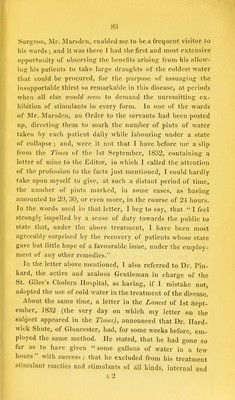
![external, as ivell as frktiuns and heat by ivhatever mcuns 2)roduced. He permitted light covering only^ as a single blanket or rug; and he said The windows of the Cholera Hospital at Gloucester are large, in proportion to the size of the room, and the door, which opens imriiediately into the garden, is seldom shut [speaking of July or August, DO doubt]. The windows are open day and night, so that the patients may be considered as living in the open air; and the tire is kept so low as not to influence the tem- perature of the room. A practice, more or less similar to this, I had certainly witnessed with benefit to the pa- tients in the course of my frequent visits to the Greville- strect Hospital, London. Dr. Shute adds that, utider tlie above system, convalescence took place sooner than under any other, and, in all cases, without consecutive fever^ which, however, I did not observe to be always the case iu other Hospitals. It was no part of the treatment adopted by those Gentle- trtcn to endeavour to stop the vomiting which was, as usual, of frequent occurrence. A portion only of the great quan- tities of water taken into the stomach may be supposed to liave been retained ; and, wherever this practice was fol- lowed, the benefit was generally admitted to have arisen from the watery part of the blood usually lost in the disease, being made up by the quantity of fluid thus swallowed.* I have noticed at page 82, that, under any treatment, reaction, in severe cases, did not seem to set in, generally, before a certain round of time. Thus far have I thought it right to speak respecting this practice ; but, as, no doubt, the attention of the profession has been recently directed to the use of large draughts of cold water, further evidence has appeared in journals m Eng^ land.-It may be remarkedjhat cold drinks had, among 7^ • • „,i u„ rir sihiitp not to be too impatient in adminis-](https://iiif.wellcomecollection.org/image/b21363997_0096.jp2/full/800%2C/0/default.jpg)

 No text description is available for this image
 No text description is available for this image
 No text description is available for this image