[Report 1936] / Medical Officer of Health, Cardiff County Borough & Port.
- Cardiff (Wales). County Borough Council.
- Date:
- 1936
Licence: Attribution 4.0 International (CC BY 4.0)
Credit: [Report 1936] / Medical Officer of Health, Cardiff County Borough & Port. Source: Wellcome Collection.
107/212 (page 87)
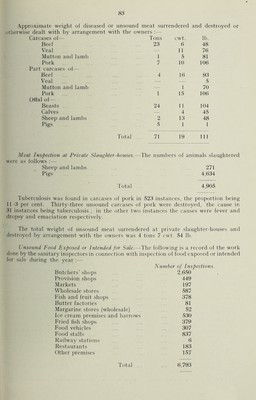
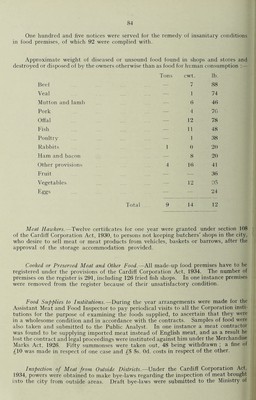
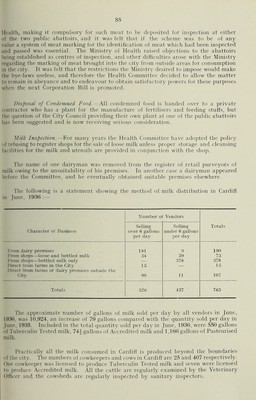
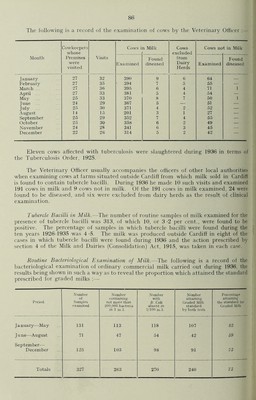
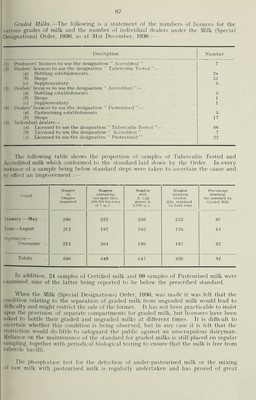
![Graded Milks.—The following is a statement of the numbers of licences for the various grades of milk and the number of individual dealers under the Milk (Special Designations) Order, 1936, as at 31st December, 1936: Description Number 1) Producers’ licences to use the designation Accredited 7 ]_>) Dealers’ licences to use the designation “ Tuberculin Tested ”— (a) Bottling establishments.. ........ 28 (b) Shops 31 (c) Supplementary 9 :;> Dealers’ licences to use the designation “ Accredited ”— (a) Bottling establishments . . 5 (b) Shops 1 (c) Supplementary 1 4) Dealers’ licences to use the designation Pasteurised ”— (a) Pasteurising establishments 5 (b) Shops 17 (.j) Individual dealers— (a) Licensed to use the designation Tuberculin Tested ”— 68 (b) Licensed to use the designation “ Accredited ” 7 (c) Licensed to use the designation “ Pasteurised ” 92 The following table shows the proportion of samples of Tuberculin Tested and Accredited milk which conformed to the standard laid down by the Order. In every instance of a sample being below standard steps were taken to ascertain the cause and to effect an improvement :— Prriod Number of Samples examined Number containing not more than 200,000 bacteria in 1 m.l. Number with H. Coli absent in 1/100 m.l. Number attaining Graded Milk standard by both tests Percentage attaining the standard for Graded Milk January —May 260 257 256 253 97 June—August 213 187 192 176 S3 September—- December .. 213 204 199 197 92 Totals 686 648 647 626 91 In addition, 24 samples of Certified milk and 99 samples of Pasteurised milk were examined, nine of the latter being reported to be below the prescribed standard. When the Milk (Special Designations) Order, 1936, was made it was felt that the condition relating to the separation of graded milk from ungraded milk would lead to difficulty and might restrict the sale of the former. It has not been practicable to insist upon the provision of separate compartments for graded milk, but licensees have been asked to bottle their graded and ungraded milks at different times. It is difficult to ascertain whether this condition is being observed, but in any case it is felt that the restriction would do little to safeguard the public against an unscrupulous dairyman. Reliance on the maintenance of the standard for graded milks is still placed on regular sampling, together with periodical biological testing to ensure that the milk is free from tubercle bacilli. 1 he phosphatase test for the detection of under-pasteurised milk or the mixing of raw milk with pasteurised milk is regularly undertaken and has proved of great](https://iiif.wellcomecollection.org/image/b28834185_0109.jp2/full/800%2C/0/default.jpg)