The American Medical Association and the United States pharmacopoeia / a reprint of the pamphlets of H.C. Wood, Alfred B. Taylor, the Philadelphia County Medical Society, and the National College of Pharmacy ; with a rejoinder addressed to the professions of medicine and pharmacy of the United States, by Edward R. Squibb.
- E. R. Squibb
- Date:
- 1877
Licence: Public Domain Mark
Credit: The American Medical Association and the United States pharmacopoeia / a reprint of the pamphlets of H.C. Wood, Alfred B. Taylor, the Philadelphia County Medical Society, and the National College of Pharmacy ; with a rejoinder addressed to the professions of medicine and pharmacy of the United States, by Edward R. Squibb. Source: Wellcome Collection.
Provider: This material has been provided by The Royal College of Surgeons of England. The original may be consulted at The Royal College of Surgeons of England.
60/159 (page 60)
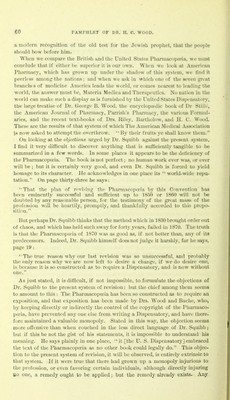
![a modern recognition of the old test for the Jewish prophet, that the people Bhould bow before him. When we compare tlie British and the United States Pharmacopa'ia, we must conclude that if either be superior it is our own. Whi-n wt- look at .Vinericjm Pharmacy, wliich has grown up under the shadow of lliis sj>tem, we tind it ])cerlc8s amontrthe nations; and when we lu^k in wliich one of the seven gn-at branchis of medicine America leads the world, or comes nearest to leading the world, the answer must be, Materia Medica and Therajn-utics. No nation in the world can make such a disi)lay as is furnished by the United States Disix-nsatory, the large treatise of Dr. George B. Wood, the encyclopatlic book of I)r SlilK', the American .lounial of Pharmacy, Parrish's Phanuacy, the various Fonnul- aries, and the recent te.xt-books of Drs. Riley, IJartholow. and II. C. WikkL These are the results of that system of which Tlie Anieriem Medical Asan-ialion is now asked to attem])t the ovt-rlhrow. By their fruits ye shall know them. On looking at tlie objtciions m-ged by Dr. Squibb ag.iinst the present sysleni, I find it very dillicult to discoviT anything that is sulficiently tangible to Ikj eunnnarizcd in a few words. In some places it appears to be the deticiency of the Pliarmacopteia. The book is not perfect; no human work ever was, or ever will be; but it is certainly very g(Kxl, and even Dr. Squibb is forced to yield homage to its character. lie acknowledges in one place its world-wide repu- tation. On page thirty-three he says: ''That the ]ilan of revising tlii' Phannncopn^ia by this Convention has been eminently successful and suffleient »ip to IS-W or 18<>(1 will not l)e doubted by any reasonable person, for the testimony of the gn at mass of the profession will be huai-tily, promptly, and thankfully accorvled to this propo- sition. But perhaps Dr. Squibb thinks that the method which in 1830 brought order out of chaos, and whieli has held such sway for forty years, failed in 1870. The trtUh is that the Pharmacopu-ia of 1870 was as goml as, if not better than, any of its pi edccessors. Indeed, Dr. Squibb himself does not judge it harshly, for he says, page 19: The true reason why our last revision was so nnsnccessfnl. and probably the only rea-son why we are now left to desin' a chang)-, if we do desire one, is l)e( ause it is so constructed as to require a Dispensiitorj, and is now without one. As just stated, it is (lillicult, if nut iini)os.sible, to fonnulute the objections of Dr. Sc|uibb to the pre.senl sy.steni of revision: but the chief .among them seems to amount to this : The Phannacopu'ia h;is been so constructed as to require an exposition, and that exposition hiVS been made by Drs. Wood and Bache, who, by keeping directly or indirectly the control of the copyright of the Pharinaco- po'ia. have prevented any one else from writing a Dispensatory, and have there- fore maintained a valuable monopoly. Stated in this way, the objection seems more offensive than when couched in the less direct language of Dr. Squibb; but if this be not the gist of his statements, it is impo.ssilile to understand his meaning. He says plainly in one place, it [the U. S. Dispensatory] eniliraced the le.xt of the PharmacoiKeia as no other book could leg-.dly do. This objec- tion to the present system of revision, it will be observed, is entirely extrinsic to that system. If it were true that there had grown up a monopoly injurious to the profession, or even favoring certain individuals, although directly injuring BO one, a remed}' ought to be applied; but the remedy already exists. lany](https://iiif.wellcomecollection.org/image/b22277584_0064.jp2/full/800%2C/0/default.jpg)