Volume 1
A compendium of human & comparative pathological anatomy / By Adolph Wilhelm Otto. Translated from the German with additional notes and references, by John F. South.
- Adolph Wilhelm Otto
- Date:
- 1831
Licence: Public Domain Mark
Credit: A compendium of human & comparative pathological anatomy / By Adolph Wilhelm Otto. Translated from the German with additional notes and references, by John F. South. Source: Wellcome Collection.
125/474 page 111
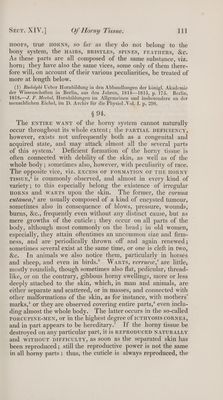
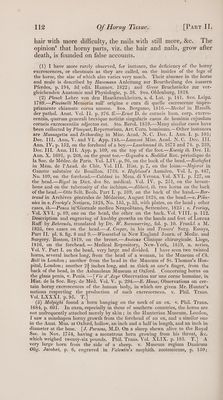
![HOOFS, true HORNS, so far as they do not belong to the bony system, the HAIRS, BRISTLES, SPINES, FEATHERS, &c. As these parts are all composed of the same substance, viz. horn; they have also the same vices, some only of them there- fore will, on account of their various peculiarities, be treated of more at length below. (1) Rudolpht Ueber Hornbildung in den Abhandlungen der kénig]. Akademie der Wissenschaften in Berlin, aus den Jahren, 1814—1815, p. 175. Berlin, 1818.—J. F. Meckel, Hornbildungen im Allgemeinen und insbesondere an der menschlichen Eichel, im D. Archiv fiir die Physiol .Vol. I. p. 298. § 94. The ENTIRE WANT of the horny system cannot naturally occur throughout its whole extent; the PARTIAL DEFICIENCY, however, exists not unfrequently both as a congenital and acquired state, and may attack almost all the several parts of this system.’ Deficient formation of the horny tissue is often connected with debility of the skin, as well as of the whole body ; sometimes also, however, with peculiarity of race. The opposite vice, viz. EXCESS OF FORMATION OF THE HORNY TISSUE,” is commonly observed, and almost in every kind of variety; to this especially belong the existence of irregular HORNS and warts upon the skin. The former, the cornua cutanea,’® are usually composed of a kind of encysted tumour, sometimes also in consequence of blows, pressure, wounds, burns, &c., frequently even without any distinct cause, but as mere growths of the cuticle; they occur on all parts of the body, although most commonly on the head; in old women, especially, they attain oftentimes an uncommon size and firm- ness, and are periodically thrown off and again renewed; sometimes several exist at the same time, or one is cleft in two, &c. In animals we also notice them, particularly in horses and sheep, and even in birds.” Warts, verruce,’ are little, mostly roundish, though sometimes also flat, pedicular, thread- like, or on the contrary, gibbous horny swellings, more or less deeply attached to the skin, which, in man and animals, are either separate and scattered, or in masses, and connected with other malformations of the skin, as for instance, with mothers’ marks,’ or they are observed covering entire parts,’ even inclu- ding almost the whole body. The latter occurs in the so-called PORCUPINE-MEN, or in the highest degree of ICTHYOSIS CORNEA, and in part appears to be hereditary.’ If the horny tissue be destroyed on any particular part, it is REPRODUCED NATURALLY and WITHOUT DIFFICULTY, as soon as the separated skin has been reproduced; still the reproductive power is not the same in all horny parts; thus, the cuticle is always reproduced, the](https://iiif.wellcomecollection.org/image/b33489166_0001_0125.jp2/full/800%2C/0/default.jpg)