Volume 1
A compendium of human & comparative pathological anatomy / By Adolph Wilhelm Otto. Translated from the German with additional notes and references, by John F. South.
- Adolph Wilhelm Otto
- Date:
- 1831
Licence: Public Domain Mark
Credit: A compendium of human & comparative pathological anatomy / By Adolph Wilhelm Otto. Translated from the German with additional notes and references, by John F. South. Source: Wellcome Collection.
66/474 page 52
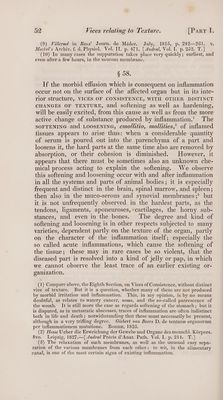
![(9) Villermé in Roux’ Journ. de Médec. July, 1815, p. 242—261. v. Meckel’s Archiv. f. d..Physiol. Vol. II. p. 471. [Andral, Vol. I. p. 252. T.] (10) In many cases the suppuration takes place very quickly; earliest, and even after a few hours, in the mucous membrane. § 58. If the morbid effusion which is consequent on inflammation occur not on the surface of the affected organ but in its inte- rior structure, VICES OF CONSISTENCE, WITH OTHER DISTINCT CHANGES OF TEXTURE, and softening as well as hardening, will be easily excited, from this cause as well as from the more active change of substance produced by inflammation.’ The SOFTENING and LOOSENING, emollitio, mollities,’ of inflamed tissues appears to arise thus: when a considerable quantity of serum is poured out into the parenchyma of a part and loosens it, the hard parts at the same time also are removed by absorption, or their cohesion is diminished. However, it appears that there must be sometimes also an unknown che- mical process acting to explain the softening. We observe this softening and loosening occur with and after inflammation in all the systems and parts of animal bodies; it is especially frequent and distinct in the brain, spinal marrow, and spleen; then also in the muco-serous and synovial membranes ;*° but it is not unfrequently observed in the hardest parts, as the tendons, ligaments, aponeuroses, «cartilages, the horny sub- stances, and even in the bones. The degree and kind of softening and loosening is in other respects subjected to many varieties, dependent partly on the texture of the organ, partly on the character of the inflammation itself; especially the so called acute inflammations, which cause the softening of the tissue; these may in rare cases be so violent, that the diseased part is resolved into a kind of jelly or pap, in which we cannot observe the least trace of an earlier existing or- ganization. (1) Compare above, the Eighth Section, on Vices of Consistence, without distinct vice of texture. But it is a question, whether many of these are not produced by morbid irritation and inflammation. This, in my opinion, is by no means doubtful, as relates to watery cancer, noma, and the so-called putrescence of the womb. It is still more the case as regards softening of the stomach; but it is disputed, as in metastatic abscesses, traces of inflammation are often indistinct both in life and death; notwithstanding that these must necessarily be present, although in a very trifling degree. Gisbert van Beers D. de tenture organorum per inflammationem mutatione. Bonne, 1825. (2) Hesse Ueber die Erweichung der Gewebe und Organe des menschl. Kérpers. 8vo. Leipzig, 1827.—[ Andral Précis d’Anat. Path. Vol. I. p. 214. T.] (3) The relaxation of such membranes, as well as the unusual easy sepa- ration of the various membranes from each other; to wit, in the alimentary canal, is one of the most certain signs of existing inflammation.](https://iiif.wellcomecollection.org/image/b33489166_0001_0066.jp2/full/800%2C/0/default.jpg)