Our Lord's miracles of healing : considered in relation to some modern objections and to medical science / by T.W. Belcher.
- Thomas Waugh Belcher
- Date:
- [between 1800 and 1899?]
Licence: Public Domain Mark
Credit: Our Lord's miracles of healing : considered in relation to some modern objections and to medical science / by T.W. Belcher. Source: Wellcome Collection.
284/316 (page 252)
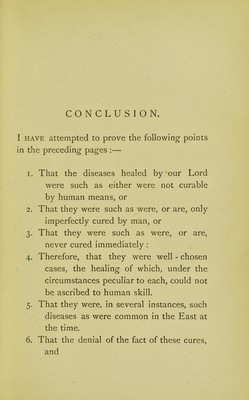
![over, the expression ‘cut off’ in the Greek of this passage is something very different from ‘ a simple cut’ Even if the Greek word [cKpelXev] did admit the sense of ‘ a simple cut,’ who that reads the context and parallel passages would imagine that the fiery and impetuous St. Peter, aiming the ‘first cut’ of a swordsman at the occiput of the high priest’s servant (as he pro- bably did, if right-handed), and missing it, would not at least clean cut off the right ex- ternal ear ? The Revised New Testament translates the ‘cut off’ of SS. Matthew, Mark, and Luke, who use the same Greek word, by ‘struck off.’ St. John uses another word [aTreVoT-e], which both the Authorized and the Revised Versions trans- late ‘ cut off.’ organ was restored to its appropriate use, was so strengthened that it was enabled to perform the task it was originally designed for. He did not give the lame a crutch to walk with. He did not give them a wooden leg. That would have been a sorry miracle, would have proved His own weakness, and not reme- died theirs. Nor did He give them wings to fly with. That would have been the work of a magician, not of a Saviour. The magician displays his own power and craftiness in making that which is not. The Saviour manifests incomparably higher power and wisdom in the far more glorious and godlike work of saving and perfecting that which is.’—Hare’s Victory of Faith—Sermon IV.; ‘Power of Faith in Man’s Natural Life,’ Ancient and Modern Theological Library.](https://iiif.wellcomecollection.org/image/b28123827_0284.jp2/full/800%2C/0/default.jpg)