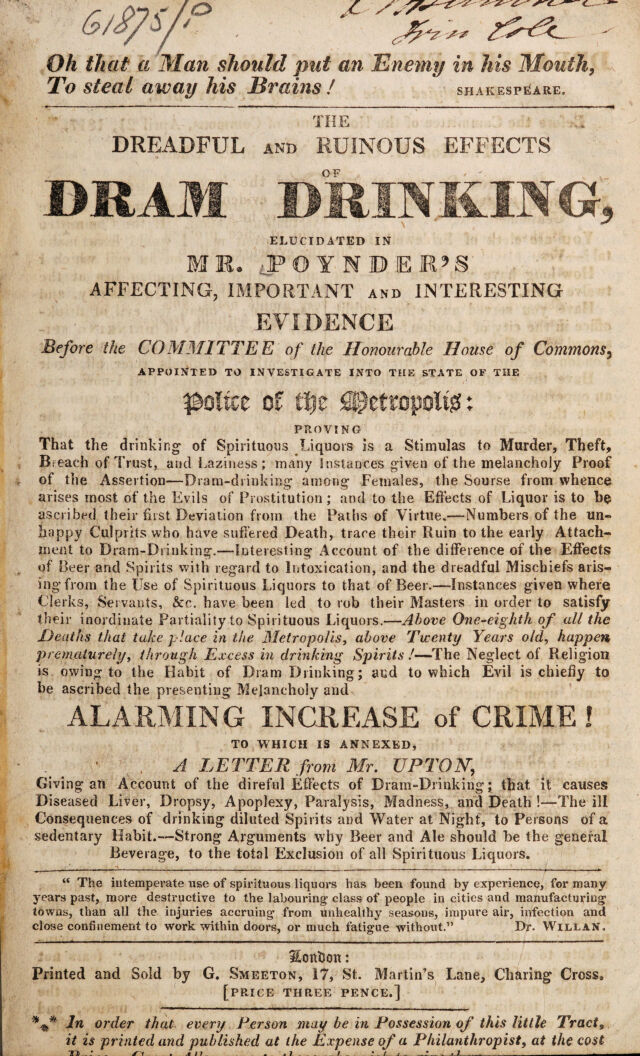
The dreadful and ruinous effects of dram drinking / elucidated in Mr. Poynder's affecting, important and interesting evidence before the Committee of the Honourable House of Commons, appointed to investigate into the state of the police of the metropolis ... ; to which is annexed, a letter from Mr. Upton, giving an account of the direful effects of dram-drinking.
- John Poynder
- Date:
- [1817?]
Licence: Public Domain Mark
Credit: The dreadful and ruinous effects of dram drinking / elucidated in Mr. Poynder's affecting, important and interesting evidence before the Committee of the Honourable House of Commons, appointed to investigate into the state of the police of the metropolis ... ; to which is annexed, a letter from Mr. Upton, giving an account of the direful effects of dram-drinking. Source: Wellcome Collection.
12/16 page 12
![( impossible at last to continue him in his place: his health followed the loss of substance, and his life, of both. This is no solitary case. With respect to the fourth point, viz. the neglect of Religion and its duties.—It appears unreasonable to make ample provision for the national religion and its institutions, and at the same time to make abundent provi¬ sion for the cultivation and extension of every description of vice. The great object of the religious instruc¬ tion which is judiciously provided by the state, is presumed to be the moral improvement of its people, and the preservation of public peace, and good order; the whole system of human law appears to come in aid of this important object. Drinking, however, induces contempt of the law of God, especially the appointment of the Sabbath—hatred to she law of man, as imposing perpetual restraint upon crime—and neglect to the public in¬ stitutions of religion, as hostile to a system of sensual indulgence, against which those institutions bear constant testimony; drinking furnishes certain temptations to the breach of the whole divine decalogue, and to the violation of all human laws. ]t is connected with, and subsists by, a system which is as opposite to the requisitions of Christianity, as error is opposed to truth, or light to darkness. For the same authority, therefore, to coun¬ tenance the two systems, appears a great contradiction, and is only to pull down with one hand what is built up with the other: the things are incom¬ patible in themselves, and the differ¬ ence between them is founded upon the eternal dis tinction, which sub¬ sists between right and wrong, and between good and evil. It need then, be no matter of surprise if the coun¬ teraction to crime afforded by the public establishment of religion, and its ministers, should be found inade¬ quate to its object, when it is consi¬ dered that persons are only pursuing the natural course to which their pas¬ sions incline them, when they yield to the temptation of drinking, which is thrown i» their way through the whole week; while the religious instruction of one day out of the seven, if not entirely slighted and neglected by such persons (as is almost universally the case) can hardly be expected to influence their reason and their judg¬ ment to such an extent, as to silence the more frequent and seductive claims preferred by their passions. The re¬ sult of my own experience among the poor, is completely in unison with this reasoning: their own ignorance of God, and themselves, as a general question, is extreme. As to the injury to health and life.— I have observed, that the children of dram-drinkers are generally of dimi¬ nutive size, of unhealthy appearance and sickly constitutions, and that in adults this vice is peculiarly destruc¬ tive in its operation ; it deranges the animal economy, weakens the nerves, destroyed the digestive powers, ob¬ structs the secretions, and destroys the life; the stomach is kept by it in a state of constant excitement, and by the frequent application of an artificial stimulus, at length loses its tone, and refuses to perform its office ; the appetite becomes vitiated, and fails; the more important organs of the body, particularly the liver and the lungs, are disturbed in their functions, and frequently become the subjects of incurable disease ; depression of spirits almost invariably accompanies dunk¬ ing, while the effect produced by every fresh stinudas is only to excite to tem¬ porary action, which, when it has ceased, leaves the same languor and depression, to be again removed by the same destructive means; almost all attacks of fever or inflammatory disease are found fatal in the case of dram-drinkers, because the blood of such persons is remarkably destitute of oxygen, and therefore can afford little or no antiseptic resistance to such diseases; in some cases dropsy and consumption, in others paralysis and apoplexy, are evident consequen¬ ces; while premature old age is ob¬ served in most instances, and a miser¬ able existence in all. Dr. Willan observes, “ The intemperate use of spirituous liquors has been found by](https://iiif.wellcomecollection.org/image/b3038896x_0012.jp2/full/800%2C/0/default.jpg)