[Report 1929] / Medical Officer of Health, Cumberland County Council.
- Cumberland County Council
- Date:
- 1929
Licence: Attribution 4.0 International (CC BY 4.0)
Credit: [Report 1929] / Medical Officer of Health, Cumberland County Council. Source: Wellcome Collection.
48/68 page 44
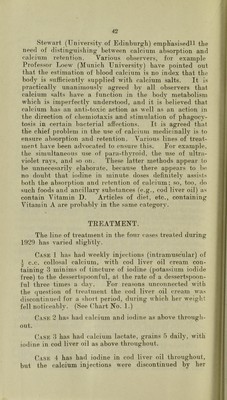
![* SUMMARY OF THE RESULTS. The results of the treatment on the orig-inal advanced case have already been referred to. W^ith regard to the four cases in the 1929 group, which, one need hardly say, are not in any sense picked cases from the point of view of results, but were the only cases under treatment during the year, the results have been taken u]i to the end of February, 19d0. These cases will continxie to be closely watched, and their progress subsequent to February, 1930^ will be included in the report for that year, together with the results of certain new cases noxv under treatment. 1 have no reason to suppose that the beneficial results indicated hereafter in these four cases will have altered in any way during 1930. In fact, in the one case (No. 4) in which a further sputum examination has been made (May, 1930), because this case had not become negative at the end of February, the sputum count has shown a still further fall in the number of tubercle bacilli present, the count being one organism per 7 fields, as compared with one in 3 fields at the end of February. With these preliminary remarks one may say that the results in all four cases in the 1929 group have been e.Tecedingly satis factory—much better than could possibly have been expected. Tt has been pointed out that two of these were genuine early cases; one was rather past the early stage, and one was definitely an advanced case with cavitation. All four cases have shown a striking improvement in general health, a marked diminution of cough and sputum and a marked increase in weight. Two of the cases were febrile at the com- mencement of treatment, and became a-febrile early in the treatment. Case No. 2 resumed work as an Insurance Agent during the year. Cases 1 and 3 were able to resume work, but neither case iiad any occupation to follow. The niost outstandiny point of interest, however, has been the remarhahle diminution in the number of tubercle bacilli present per tnicroscopic field in all four cases. When treatment began, one of the cases had 23 <.ul)ercle bacilli present in the sputum j)er microscopic field, two had 11 per field, and one had three per field. As shown in the Table which folloAvs, three of the four * 'See Page .13.](https://iiif.wellcomecollection.org/image/b29132903_0050.jp2/full/800%2C/0/default.jpg)