Licence: Public Domain Mark
Credit: Physiology of the nervous system / by Robert B. Todd. Source: Wellcome Collection.
Provider: This material has been provided by The Royal College of Surgeons of England. The original may be consulted at The Royal College of Surgeons of England.
14/72 (page 14)
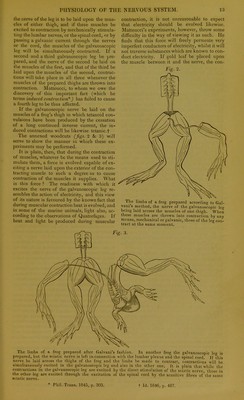
![tractions of the galvanoscopic leg will not take place. If, however, a slight tear be made in the gold leaf, then the nerve may be excited. It is possible that this may arise from the electricity being carried off by the gold leaf, so that it does not affect the nerve at all. Matteucci never succeeded in obtaining the induced con- tractions when a solid body was interposed between the nerve and muscle, however thin it might have been and whatever might be its nature; for this purpose he used flakes of mica extremely thin, Hakes of sulphate of lime, gold leaf, pajter smeared with glue, and leaves of vegetables.* On the other hand, in interposing some sub- stances which are known to be bad conductors of electricity, the contractions were obtained. The induced contractions may be excited if the nerve be laid upon the skin over the muscles of the inducing frog. “ The experiment,” says Matteucci, “ never fails of success, whether the inducing contraction be excited by the electric current.or by any stimulus applied to the lum- bar plexuses of the inducing frog.” The use of a very bad conducting body, Venice turpen- tine, did not prevent the induced contractions. The nearly solid Venice turpentine was ren- dered more or less liquid by adding to it a little of the volatile oil of turpentine, and with this the muscles were smeared over, and the nerve of the galvanoscopic frog was wetted. To prove the bad conducting powers of the mixture em- ployed, one pole or the exciting pile was a]t- plied to the muscle and the other to the galva- noscopic frog without exciting the least con- traction. Yet the contractions were induced in the galvanoscopic frog by stimulating the muscles of the thigh. This experiment clearly proved, as Matteucci remarks, that the induced contraction may be excited through a stratum of an insulating substance that prevents the propagation not only of the muscular and proper currents, but also of that current which excites the inducing contraction. We are forced then by the results of the re- markable experiments above detailed to adopt the conclusion at which Matteucci has himself arrived—that there is no current of electricity in the act of muscular contraction. What then is the evolved force ? It is either an electric discharge\ or a force very analogous to electri- city, afl'ecting nerves in a similar way, travelling apparently with great rapidity, traversing bodies which the galvanic current cannot traverse, and yet restrained by substances which freely con- duct it. I confess myself at a loss to understand how Matteucci comes to regard this as a phenomenon of the nervous force. In truth, it is a pheno- menon which accompanies muscular contrac- • Phil. Trans. 1845, On induced contractions. t From a letter addressed to M. Dumas by Pro- fessor Matteucci, and published in the Comptes Keiidus for March 15, 1847, it appears that ho now is rather disposed to regard it as an electric dis- charge, as he says, C’est apres avoir prouve quo des decharges clectriques de la bouteillc tcllement faibles qu’elles ne pouvent etre montrbes par aucun instrument, excepte par la grcnouille, que j’ai pensc que la contraction induitc poiivait etro due il unc decharge electrique de cc genre.” tion, and has no relation to the nervous force, excepting so far as that is the excitant of the muscular action. The essential point of the phenomenon is, that during the contraction of a muscle a nerve which is laid on it is stimulated just as it would be by electricity, and causes the muscles to which it is distributed to contract. The electric discharge from a muscle which is excited to contract through the exercise of ner- vous power is in close analogy with the electric discharge from the electrical organ of the Gymnotus or Torpedo, which is excited through the same agency. Now the proved existence of a muscular force, the developement of which is accompa- nied with heat, and most probably electricity, and in some instances, if the statements of Quatrefages be correct, with light, justifies us in adopting the opinion, as regards the nervous force, that this is of an analogous kind, yet exhi- biting still less resemblance to electricity than the muscular force; and it strikingly illustrates the remark of Faraday, that if there be reasons for supposing that magnetism is a higher rela- tion of force than electricity, so it may well be imagined that the nervous power may be of a still more exalted character and yet within the reach of experiment. We are thus led to these conclusions respect- ing the muscular and nervous forces. 1. That both are polar forces and in close analogy with light, heat, electricity—magnetism. 2. That either may be excited by or trans- formed into the other—the nervous may excite the muscular, or the muscular the nervous. It seems not improbable that it is by this reaction of the muscular upon the nervous force that the muscular sense is developed, and as Matteucci has ingeniously suggested, many movements independent on the will, yet following others which maybe voluntary or otherwise, may result from the same cause. 3. That the same analogy which exists be- tween electricity and magnetism is found be- tween these organic polar forces ; the muscular being more nearly allied to the former, the ner- vous to the latter. 4. Both these forces are dependent on the healthy nutrition of their respective tissues, muscle and nerve, and the slightest disturbance in that process in either tissue will readily affect the intensity of the force. 5. Nevertheless there is a certain mutual de- pendence between these two tissues and their forces; for the exercise of each is, within certain limits, impossible without the other; and as this exercise is necessary to maintain healthy nutrition, so these forces are to a certain extent dependent on each other for their normal deve- lopement. The practitioner in medicine will duly appreciate the great importance of this conclusion. The mutual reactions of the nervous and muscular forces constitute a new and highly important field of inquiry, which, if duly culti- vated, may clear up many obscurities in the physiology and pathology of the nervous system. Having thus far considered certain generali- ties in tiie physiology of the nervous system, we may now proceed to inquire into the share](https://iiif.wellcomecollection.org/image/b22332807_0016.jp2/full/800%2C/0/default.jpg)