The ancient physician's legacy to his country. Being what he has collected in fifty-eight years of practice, or, An account of the several diseases incident to mankind ... Designed for the use of all private families ... / [Thomas Dover].
- Thomas Dover
- Date:
- 1742
Licence: Public Domain Mark
Credit: The ancient physician's legacy to his country. Being what he has collected in fifty-eight years of practice, or, An account of the several diseases incident to mankind ... Designed for the use of all private families ... / [Thomas Dover]. Source: Wellcome Collection.
4/266
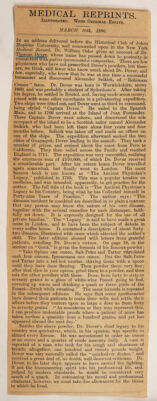
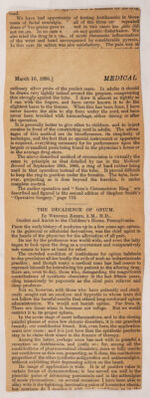
![W1.X UA UVJ eu uuieraiice lor oue ux ug -Aised. We have had opportunity of testing Antikamnia in three^ cases of facial neuralgia. T all of the three ca° repeated! doses o* hve grains gave re and in two cases tile pain did not return. In no case w ere any gastric disturbance. We also tried the drug in a cas„ of acute rheumatic inflammation of the wrist and hand accompanied by considerable pyrexia. In this case its action was also satisfactory. The pain was at _. —* a . .1 /» • i j _ n A- March 16, 1896.] MEDICAL ordinary silver probe of the pocket cases. In adults it should be drawn very tightly indeed around the prepuce, compressing this strongly against the tube. I draw it almost as tightly as I can with the fingers, and have never known it to do the slightest harm to the tissues. When this has been done, I have never known the skin to slip from under the cord, and have never been troubled with haemorrhage, either during or after the operation. It is generally better to give ether to children, and to inject cocaine in front of the constricting cord in adults. The advan¬ tages of this method are its bloodlessness, its simplicity of technique, and the fact that no special instrument or apparatus is required, everything necessary for its performance upon the largest or smallest penis being found in the physician’s house or in the average drug-store. The above-described method of circumcision is virtually the same in principle as that detailed by me in the Medical Record of September 26th, 1885, a ring of hard rubber being used in that operation instead of the tube. It proved difficult to keep the ring in position under the foreskin. The tube, how¬ ever, projecting as it does beyond the foreskin, is under complete control. The earlier operation and “Boss’s Circumcision Bing” are described and figured in the second edition of Stephen Smith’s “Operative Surgery,” page 712. THE DECADENCE OF OPIUM. By Wendell Beber, A.M., M.D., Oculist and Aurist to the Children’s Home, Pennsylvania. From the early history of medicine up to a few years ago, opium, in its galenical or alkaloidal derivatives, was the chief agent in the hands of the physician for the alleviation of all pain. Its use by the profession was workbwide, and even the laity began to look upon the drug as a convenient and comparatively safe means to have at hand for relief. The crowded condition of institutions for opium habitues to-day proclaims all too loudly the evils of such an indiscriminate practice ; and though many a medical man has had reason to reproach himself for introducing his patient to the alluring drug, there are, even to-dajy those who, disregarding the magnificent contributions of synthetic chemistry in the last fifteen years, cling tenaciously to papaveris as the ideal pain reliever and sleep producer. Not so, however, with those who have patiently and studi¬ ously sought out an anodyne and hypnotic in whose train did not follow the baneful results that attend long-continued opium administration. We would not banish opium. Far from it. There are times when it becomes our refuge. But we would restrict it to its proper sphere. In the acute stage of most inflammations, and in the closing painful phases of some few chronic disorders, it is our grandest remedy, our confidential friend. But, even here, the application must now cease ; and it is just here that the synthetic products step in to claim their share in the domain of therapy. Among the latter, perhaps none has met with so grateful a reception as Antikamnia, and justly so; for, among all the contributions of pharmaceutical chemistry, none so fully merits our confidence as this one, presenting, as it does, the meritorious properties of the other synthetic antipyretics and antineuralgics, without exhibiting their depressing action on the heart. Its range of apphcation is wide. It is of positive value in certain forms of dysmenorrhoea; it has served me well in the pleuritic pains of advancing pneumonia and in the arthralgias of acute rheumatism ; on several occasions I have been able to allay with it the lightning, lancinating pains of locomotor ataxia; but nowhere do I emnlov it wi+.L Qa in](https://iiif.wellcomecollection.org/image/b30542200_0004.jp2/full/800%2C/0/default.jpg)