Volume 2
Animal chemistry with reference to the physiology and pathology of man / by J. Franz Simon ; translated and edited by George E. Day.
- Johann Franz Simon
- Date:
- 1845
Licence: Public Domain Mark
Credit: Animal chemistry with reference to the physiology and pathology of man / by J. Franz Simon ; translated and edited by George E. Day. Source: Wellcome Collection.
Provider: This material has been provided by King’s College London. The original may be consulted at King’s College London.
399/584 (page 383)
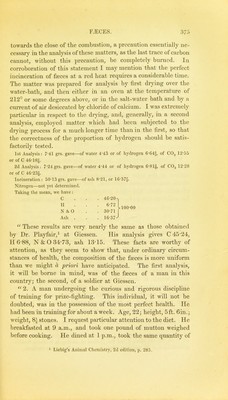
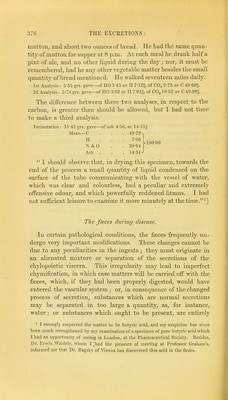
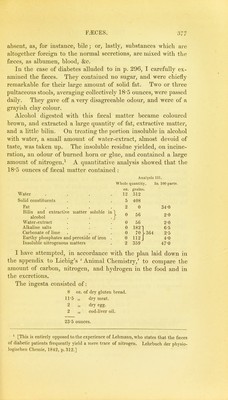
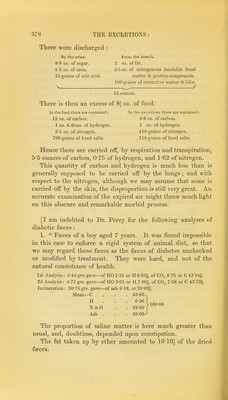
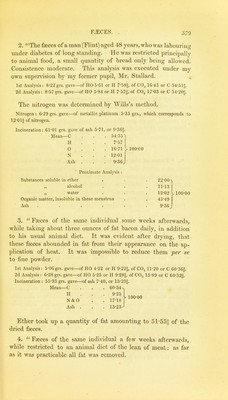
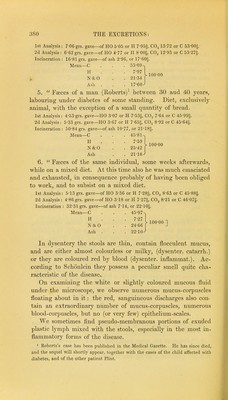
![tion of the fluid he obtained in the receiver a liquid with an alkahne reaction, and having a fishy odour. On the addition of nitric acid tliis liquid assumed a beautiful red tint, which it retained during evaporation. The fluid, when concentrated, had an intense red colour, but was devoid of odour, which only be- came again apparent on neutralizing the free acid by an alkali. The portion that remains in the retort after the distillation of the fluid contains traces of albumen, some intestinal mucus, the ordinary salts of the animal fluids, and a large amount of carbonate of soda. Wittstock’s researches respecting the faecal discharges in cholera, coincide in most points with those of Vogel: he ob- served the beautiful rose-red tint that was produced by the ad- dition of nitric acid, and he ascribed it to the presence of an m’ate; it is however known, that the formation of purpurate of ammonia or murexid from lu'ic acid, requires a greater de- gree of concentration of the reacting substances, and a height- ened temperature. The faeces of a woman who had a very severe attack of sporadic cholera, (whose blood and m’ine I likewise analysed,) formed a turbid and colomdess fluid, which had a strong alkaline reaction, and effervesced on the addition of acids, giving off carbonic acid and sulphuretted hydrogen, which, in all probability, ai’ose from cai’bonate of ammonia and sulphm’et of ammonium (hydi’osulphate of ammonia). When allowed to stand for some time it formed a sediment, which consisted, for the most part, of mucus-corpuscles, with some crystals of ammoniaco-magnesian phosphate. No epi- thelium cells were observed. On treating the fluid with nitric acid, effervescence took place, and flocculi of coagulated albumen separated themselves; moreover, the fluid in a short time be- came of a rose-red colom’,—a phenomenon that was induced more rapidly by gentle warmth ; when strongly heated for some time the colour entirely disappeared.' The quantitative analysis of the faecal discharge in this case gave the following results, calcidated for 1000 parts :— ' [In an examination of the fteces in cholera, instituted by Heller, (Archiv i, p. 18,) a similar reaction was observed. The exact nature of the change that the bile-pigment undergoes in such cases is not clearly understood.]](https://iiif.wellcomecollection.org/image/b21301852_0002_0399.jp2/full/800%2C/0/default.jpg)