Volume 2
Animal chemistry with reference to the physiology and pathology of man / by J. Franz Simon ; translated and edited by George E. Day.
- Johann Franz Simon
- Date:
- 1845
Licence: Public Domain Mark
Credit: Animal chemistry with reference to the physiology and pathology of man / by J. Franz Simon ; translated and edited by George E. Day. Source: Wellcome Collection.
Provider: This material has been provided by King’s College London. The original may be consulted at King’s College London.
477/584 (page 461)
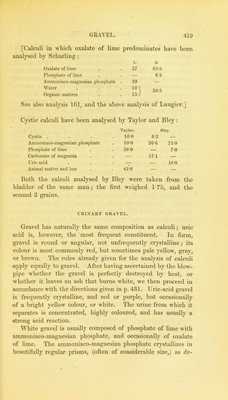
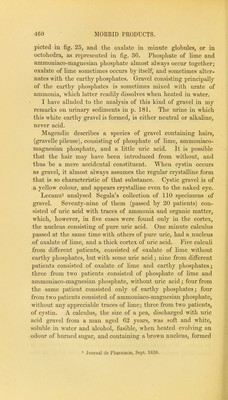
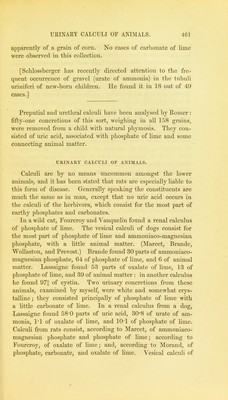
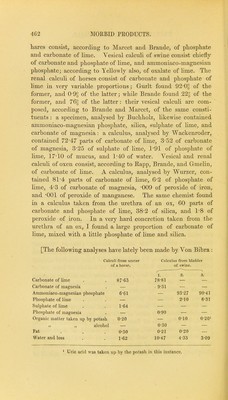
![apparently of a grain of corn. No cases of carbonate of lime were observed in this collection. [Scblossberger bas recently directed attention to the fre- quent occui’rence of gravel (urate of ammonia) in the tubuli uriniferi of new-born children. He found it in 18 out of 49 cases.] Preputial and urethral calcuh have been analysed by Romer: fifty-one concretions of this sort^ weighing in all 158 grains^ were removed from a child with natural phymosis. They con- sisted of uric acid, associated with phosphate of lime and some connecting animal matter. URINARY CALCULI OF ANIMALS. Calculi are by no means uncommon amongst the lower animals, and it has been stated that rats are especially hable to this form of disease. Generali}' speaking the constituents are much the same as in man, except that no uric acid occurs in the calcuh of the herbivora, which consist for the most part of earthy phosphates and carbonates. In a wild cat, Fourcroy and Vauquelin found a renal calculus of phosphate of hme. The vesical calculi of dogs consist for the most part of phosphate of lime and ammoniaco-magnesian phosphate, with a Httle animal matter. (Marcet, Brande, Wollaston, and Prevost.) Brande found 30 parts of ammoniaco- magnesian phosphate, 64 of phosphate of lime, and 6 of animal matter. Lassaigne found 53 pai’ts of oxalate of lime, 13 of phosphate of hme, and 39 of animal matter : in another calculus he found 97§ of cystin. Two urinary concretions from these animals, examined by myself, were white and somewhat crys- talline ; they consisted principahy of phosphate of hme with a httle carbonate of hme. In a renal calculus from a dog, Lassaigne found 58 0 parts of uric acid, 30*8 of urate of am- monia, I’l of oxalate of hme, and lOT of phosphate of hme. Calcuh from rats consist, according to Marcet, of ammoniaco- magnesian phosphate and phosphate of hme; according to Fourcroy, of oxalate of hme; and, according to Morand, of phosphate, carbonate, and oxalate of hme. Vesical calcuh of](https://iiif.wellcomecollection.org/image/b21301852_0002_0477.jp2/full/800%2C/0/default.jpg)