Licence: Attribution-NonCommercial-NoDerivatives 4.0 International (CC BY-NC-ND 4.0)
Credit: Blood groups in man / by R.R. Race and Ruth Sanger. Source: Wellcome Collection.
164/434 page 140
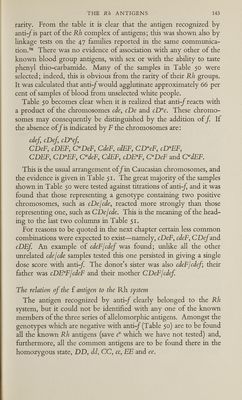
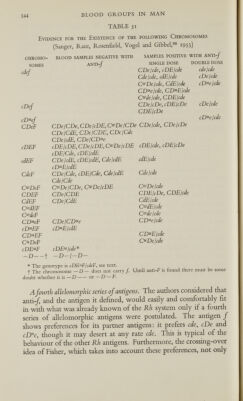
![In the serum of the —D —/ —D — woman there was found anti-e, anti-C and anti-r; the presence of both anti-C and anti-c in one serum was extraordinary but not altogether unexpected in a person lacking any C ore antigens. The authors considered three possible genetic interpretations, they say: (1) The C and E loci may be represented by unknown, silent allelomorphs. This is unlikely, for all the known allelomorphs produce antigens which are easily detectable; it is highly improbable because two of this new kind of allelo morph, one at the C and the other at the E locus, would have to be postulated on the same chromosome. (2) A suppressing gene may be at work. It is difficult to imagine that such a gene would suppress all activity at the C and E loci yet not at the D locus. More over, the presence of C or c antigens, even when suppressed, would surely be incompatible with the existence in the serum of both anti-C and anti-c. (3) Deletion of a portion of the Rh chromosome seems to offer the most satis fying explanation. It would fit well with the total absence of the C and E antigens and might explain the exalted D antigen. We have for some time had evidence that suggests that a common basic material of limited amount is available for the production of the CDE antigens. Freed from the competition of C and E, D might take all such hypothetical raw material. That the deletion is probably a short one is suggested by the good health of the donor and by the absence of any other congenital abnormality. Whatever the exact genetic mechanism, the fact that C and E are involved, supports from an unexpected angle Fisher’s tentative suggestion[ 28 ] that the order of the genes on the chromosome would be found to be DCE. It also seems that the very controversial question whether the genes are separable or not is settled in the most convincing way of all—by their separation. Three years later, in 1953, Waller, Sanger and Bobbitt 131 to their great surprise found that two white Virginians, a sister and her brother, were of the genotype — D— /— D —; again the parents were related, this time first cousins. Though of British stock it was not possible to trace any relationship with the previous family. Attention was drawn to the Virginian family when the sister was being prepared for a fifth blood transfusion. Her serum sensitized the red cells of 250 prospective group O donors but not those of her brother nor, later, those of the British —D—/—D — person; it obviously contained several antibodies of which only anti-e was identified. Conversely, her red cells and those of her brother were not agglutinated by the serum of the British woman for whom it had previously been thought that there was perhaps no compatible blood donor in the world.](https://iiif.wellcomecollection.org/image/b18026631_0164.JP2/full/800%2C/0/default.jpg)
 No text description is available for this image
 No text description is available for this image
 No text description is available for this image