Questions in physiology and hygiene asked at the examinations held by the New York state board of medical examiners : complete, with references and answers to every question / Comp. and ed. by R.J.E. Scott.
- Scott, R. J. E. (Richard John Ernst), 1863-1932
- Date:
- [1905]
Licence: Public Domain Mark
Credit: Questions in physiology and hygiene asked at the examinations held by the New York state board of medical examiners : complete, with references and answers to every question / Comp. and ed. by R.J.E. Scott. Source: Wellcome Collection.
Provider: This material has been provided by the Augustus C. Long Health Sciences Library at Columbia University and Columbia University Libraries/Information Services, through the Medical Heritage Library. The original may be consulted at the the Augustus C. Long Health Sciences Library at Columbia University and Columbia University.
22/416 (page 23)
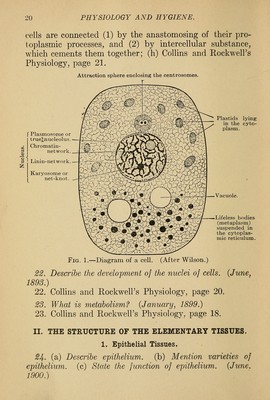
![25. Describe epithelium as to (d) origin, (e) shape, (f) location, (c) function. (September, 1901.) 26. (c) What are the functions of epithelium? {January, 1898.) 24 to 26. (a) Collins and Rockwell's Physiology, page 23; (b) page 23; (c) page 24; (d) epithelium originates from the epiblast or hypoblast; endothelium from the mesoblast; (e) Collins and RockwelFs Physiology, page 23; (f) pages 23 and 24; and see Q. 886. 27. Name, locate, and give the function of each of the varieties of epithelia. {September, 1896.) 28. Give the principal location of the different varieties of epithelium. {April, 1899.) 29. Give the functions and locality of each of the different varieties of epithelia. {November, 1893.) 27 to 29. Collins and RockwelFs Physiology, pages 23 and 24. 30. (a) Describe ciliated epithelium and (b) state where it is found most abundantly, (c) What is the function of ciliated epithelium? {April, 1898.) 30. (a) Collins and Rockwell's Physiology, page 24. (b) ^'The situations in which ciliated epithelium is found in the human body are: the respiratory tract from the nose downward to the smallest ramifications of the bronchial tube (except a part of the pharynx and the surfgtce of the vocal cords), the tympanum and Eustachian tube, the Fallopian tube and upper portion of the uterus, the vasa efferentia, coni vasculosi, and the first part of the excretory duct of the testicle, and the ventricles of the brain and central canal of the spinal cord.'' (Gray's Anatomy.) (c) Motion and protection. 31. (a) Describe ciliary motion] (b) describe protoplasmic movement. {April, 1895.) 31. (a) ''When Hving ciliated epithelium is examined under the microscope, the cilia are seen to be in constant](https://iiif.wellcomecollection.org/image/b21207744_0022.jp2/full/800%2C/0/default.jpg)