[Report 1923] / Medical Officer of Health, Denbighshire County Council.
- Denbighshire (Wales). County Council. no2004062613.
- Date:
- 1923
Licence: Attribution 4.0 International (CC BY 4.0)
Credit: [Report 1923] / Medical Officer of Health, Denbighshire County Council. Source: Wellcome Collection.
29/42 (page 26)
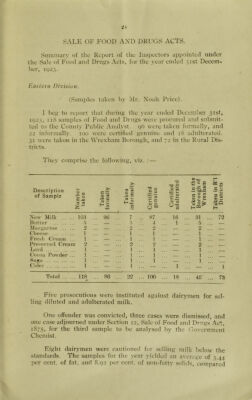
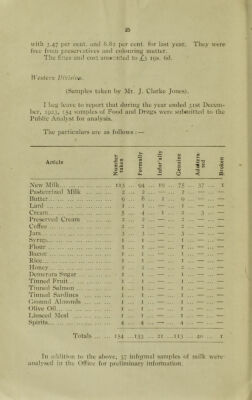
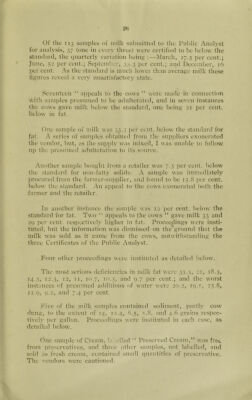
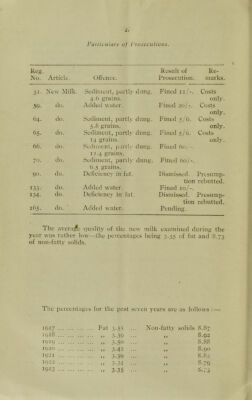
![Of tliu 113 samples of milk suhmiUed to the Public Analyst for analysis, 37 (one in e\'ery three) were certified to be below the standard, the (piarterly \-ariation beini>' :—INIarch, 27.3 per cent.; June, 52 ]X“r cent.; vSeptember, 35.3 jicr cent.; and December, 16 per cent. As the standard is much lower than averaf^e milk the.se fs:nres reveal a \ ery unsatisfactory state. .Seventeen “ a])]X‘als to the cows ” were made in connection with sami)les presumed to be adulterated, and in seven instances the cows save milk below the standard, one being 21 per cent, below in fat. One sample of milk was 33.3 per cent, below the standard for fat. A series of samj^les obtained from the suppliers exonerated the vendor, but, as the supply was mi.xed, I was unable to follow up the ]>rcsumed adulteration to its source. Another sample bought from a retailer was 7.3 per cent, below the standard for non-fatty solids.- A sample was immediately procured from the farmer-supplier, and found to be 15.8 per cent, below the standard. An appeal to the cows exonerated l)Ot]i the farmer and the retailer. In another instance the sample was 12 per cent, below the standard for fat. Two “ appeals to the cows ” gave milk 33 and 29 per cent, respectively higher in fat. Proceedings were insti- tuted, but the information was dismissed on the ground that the milk was sold as it came from the cows, notwithstanding the three Certificates of the Public Analyst. Four other jirocecdings were instituted as detailed below. The most serious deficiencies in milk fat were 33-3, ei, 1S.3, 14.3, T2.3, 12, II, 10.7, 10.3, and 9.7 ])er cent.; and the worst instances of presumed additions of water were 20.2, 19.1, 15.8, II.9, 9.2, and 7.4 per cent. Five of the milk samples contained sediment, partly cow dung, to the extent of izj, 12.4, 6.5, ^.8, and 4.6 grains respec- tively jier gallon. Proceedings were instituted in each case, as detailed below. One sample of Cream. Ir.'.elled “ Preserved Cream,” was free from ]ircservati\-es, and three other samples, not labelled^ and sold as fresh cream, contained small quantities of prc.servative. The vendors were cautioned.](https://iiif.wellcomecollection.org/image/b28840719_0029.jp2/full/800%2C/0/default.jpg)