Prospectus of fifteen lectures on the animal and intellectual economy of man : adapted to the purposes of the medical practitioner, the speculative philosopher, the parent, and the youth, as the medium of that knowledge of God and ourselves, which seems connected with health, piety, and religion / by Alexander Ramsay, M.D. (formerly of Edinburgh,) teacher of anatomy, physiology, &c. &c.
- Ramsay, Alexander, 1754?-1824.
- Date:
- 1816
Licence: Public Domain Mark
Credit: Prospectus of fifteen lectures on the animal and intellectual economy of man : adapted to the purposes of the medical practitioner, the speculative philosopher, the parent, and the youth, as the medium of that knowledge of God and ourselves, which seems connected with health, piety, and religion / by Alexander Ramsay, M.D. (formerly of Edinburgh,) teacher of anatomy, physiology, &c. &c. Source: Wellcome Collection.
Provider: This material has been provided by the National Library of Medicine (U.S.), through the Medical Heritage Library. The original may be consulted at the National Library of Medicine (U.S.)
21/24
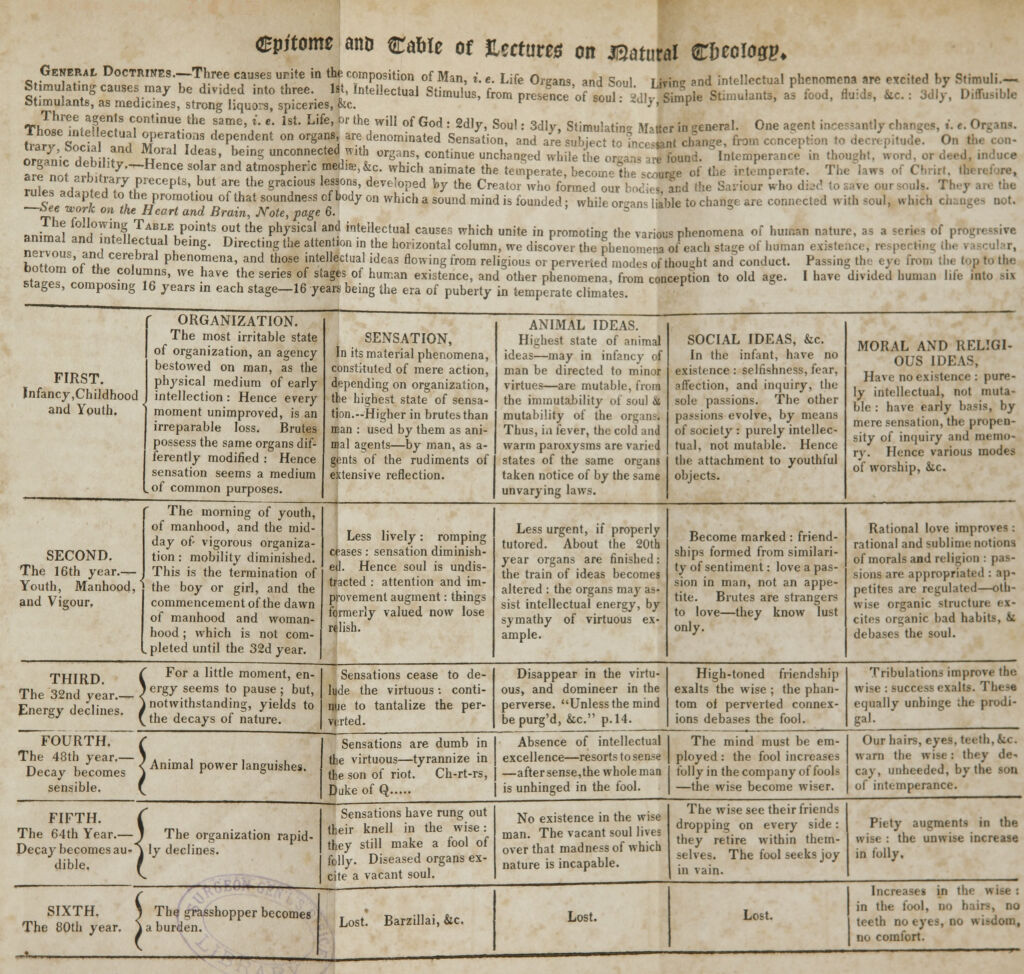
![Epitome and Cable of factum on Natural CDeologp* ■tSSSS ^°0CTR,NESTT,hr^ ?USeS Uuite in %crPnSiti0n 0f Man' *■ •■ Life O^ns, and Soul Urine and intellectual phenomena are excited by Sthwdi^ lllmffi Stimulus,frorapreSegnceWsoul:UklI}Sle Stimulants, .5 food, fluid* *c.: 3d,/, Difu.ibfe ThI8her1ntX!LC.°ntinU!the fme' J C* 1St* Life' °f the,WU1 °f God: 2d^' Soul: Sdly, Stimulating Matter in general. One aeent incessantly change*, i. .. Or tTansocial !nf JT I iT deP™dent on <&?* Renominated Sensation, and are subject to incest change, from conception orSn'ir S li? u f *' bfinS uncLonnecteVlth. wrga^, continue unchanged while the organs are found. Intemperance in t] . r d< ed, fa organic aebility.—Hence solar and atmosDhenc media. &c. whiVh nn;mof^ fkQ t..,„ ... i °, ... .-.,, oreanir rlphilit^ H i , *5 T r . w6««». »-«uu«ue uncnangeu while the organs are found, intemperance in tnoi are not art, r-£7 ? ^ ♦ a*m08Ph.enc ,med!a^- which animate the temperate, become the scourge of the intemperate. The rnl^ST?yi P ' -but aJe the §raC,0US 'r,S' devei°ped by the Creator who formed our bodies and the Saviour who di3<! ruies adapted to the proraotiou of that soundness cf body on which a sound mind is founded: while organs liable to change are connected with soul, which changes not oee wortc on the Heart and Brain, Note, page 6- The laws of C irS ini°3i^f.iLi\??-°tS ^Ut the- fh7,aiC^i in!eHectual causes which unite in promoting the various phenomena of human nature, as a series of p&gr< ssive column, we discover the phenomena of each stage of human e I r, r*r\m kaIi «-*»*-...,- ^_ /. __1. 1 /• ■ 1 Li .] ~ .^ .i . 1 . . «* Pnrrlnir tlw, £\ *rr\ fi«Am (li*i fnn fit tnn nr?n, c.n ,,ntel,e,ctu1al Jeing. Directing the attention in the horizontal column, we discover the phenomena of each stage oi ban En n!I tu Cere.bral Phenomena, and those intellectual ideas flowing from religious or perverted modes of thought and conduct TIT °l colu™ns> we have the series of stages of human existence, and other phenomena, from conception to old age stages, composing 16 years in each stage-16 years being the era of puberty in temperate climates. Passing the eye from the ton to the I have divided human life into sii FIRST. Infancy,Childhood and Youth. ORGANIZATION. The most irritable state of organization, an agency bestowed on man, as the physical medium of early intellection: Hence every moment unimproved, is an irreparable loss. Brutes possess the same organs dif- ferently modified : Hence sensation seems a medium Lof common purposes. SENSATION, In its material phenomena, constituted of mere action, depending on organization, tlie highest state of sensa- tion.-Higher in brutes than man : used by them as ani- mal agents—by man, as a- gents of the rudiments of extensive reflection. ANIMAL IDEAS. Highest state of animal ideas—may in infancy of man be directed to minor virtues—are mutable, from the immutability of soul ii mutability of the organs] Thus, in fever, the cold and warm paroxysms are varied states of the same organs taken notice of by the same unvarying laws. SOCIAL IDEAS, &c. In the infant, have no existence: selfishness, fear, affection, and inquiry, the sole passions. The other passions evolve, by means of society : purely intellec- tual, not mutable. Hence the attachment to youthful objects. MORAL AND RELIGI- OUS IDEA-. Have no existence : pure- ly intellectual, not muta- ble : have early basis, by mere sensation, the propen- sity of inquiry and memo- ry. Hence various modes of worship, &c. SECOND. The 16th year.— . Youth, Manhood, and Vigour. The morning of youth, of manhood, and the mid- day of- vigorous organiza- tion : mobility diminished. This is the termination of the boy or girl, and the commencement of the dawn of manhood and woman- hood ; which is not com- pleted until the 32d year. Less lively: romping erases: sensation diminish- ed. Hence soul is undis- tncted : attention and im- provement augment: things formerly valued now lose relish. Less urgent, if properly tutored. About the 20th year organs are finished: the train of ideas becomes altered : the organs may as- sist intellectual energy, by symathy of virtuous ex- ample. Become marked : friend- ships formed from similari- ty of sentiment: love a pas- sion in man, not an appe- tite. Brutes are strangers to love—they know lust only. Rational love improves : rational and sublime notions of morals and religion : pas- sions are appropriated : ap- petites are regulated—otb- wise organic structui- citfs organic bad habit.-, & debases the soul. THIRD. The 32nd year.— Energy declines. FOURTH, The 48th year.— Decay becomes sensible. For a little moment, en- ergy seems to pause ; but, notwithstanding, yields to the decays of nature. Sensations cease to de- lude the virtuous: conti- nue to tantalize the per- verted. ?An imal power languishes. Sensations are dumb in the virtuous—tyrannize in the son of riot. Ch-rt-rs, Duke of Q Disappear in the virtu- ous, and domineer in the perverse. Unless the mind bepurg'd, &c. p. 14. Absence of intellectual excellence—resorts to sense —after sense,the whole man is unhinged in the fool. High-toned friendship exalts the wise ; the phan- tom oi perverted connex- ions debases the fool. Tribulations improve the wise : success exalts. These equally unhinge the prodi- gal- The mind must be em- ployed : the fool increases folly in the company of fools —the wise become wiser. Our hairs, eyes, teeth, &c. warn the wise : they de- cay, unheeded, by the son of intemperance. FIFTH. The 64th Year.— Decay becomes au- dible. The organization rapid- ly declines. Sensations have rung out their knell in the wise: they still make a fool of folly. Diseased organs ex- cite a vacant soul. No existence in the wise man. The vacant soul lives over that madness of which nature is incapable. The wise see their friends dropping on every side: they retire within them- selves. The fool seeks joy in vain. Piety augments in the the unwise increase in folly. SIXTH. The 80th year. The grasshopper becomes a burden. Lost. Barzillai, &c. Lost. Lost. Increases in the in the fool, no bain, no teeth no eyes, no wisdom, no comfort.](https://iiif.wellcomecollection.org/image/b21149124_0021.jp2/full/800%2C/0/default.jpg)