Twins : a study of heredity and environment / by Horatio H. Newman, Frank N. Freeman, Karl J. Holzinger.
- Horatio Hackett Newman
- Date:
- [1937]
Licence: Attribution-NonCommercial 4.0 International (CC BY-NC 4.0)
Credit: Twins : a study of heredity and environment / by Horatio H. Newman, Frank N. Freeman, Karl J. Holzinger. Source: Wellcome Collection.
57/398 (page 37)
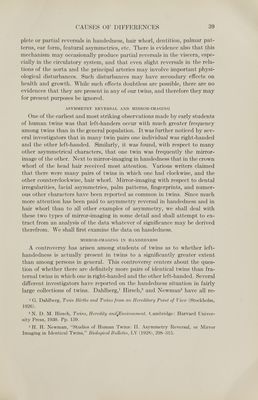
![CAUSES OF DIFFERENCES 37 But when, as is usually the case, the two vascular invasions proceed from opposite sides of the placental disk, they meet toward the center of the area and compete for this area. The blood vessels, capillaries, veins, and arter¬ ies of the two individuals push into the same area and come closely in con¬ tact with one another. There occur as the result of contact more or less extensive fusions, or anastomoses of capillary with capillary, artery with artery, and vein with vein of opposite individuals. In the majority of cases only capillary anastomoses occur, and little or no damage is done; but in many cases, where fairly extensive arterial and venous anastomoses occur, there are serious consequences. Whenever there are anastomoses of this sort, much of the welfare of the twins depends on whether such anastomoses are symmetrical or asymmetrical. A symmetrical situation involves a fair and even exchange of blood between the twins, and all is well with both; but, if there is an imbalance between the amount of blood leaving the cir¬ culation of one twin and that coming back from the other twin, a serious situation arises, the degree of seriousness being proportional to the extent of the vascular imbalance. Both twins may be seriously injured, but usually the twin that progressively loses blood is more damaged than the one that gains blood. Often the heart of the twin that loses blood dies of inanition, and circulation of both twins goes on for a time through the labor of the heart of the surviving twin, whose heart enlarges to meet the extra work required of it. Such extreme cases as these do not especially concern us in our attempt to get at the causes of differences in twins that have been born and have grown up, but there can be little doubt that twins with minor imbalance in the placental anastomoses do survive and show minor degrees of the same types of effect described for extreme cases. It is commonly believed that one member of each pair of identical twins is lacking in vitality as compared with the other. Many even believe that one member of each pair is sterile. While such views as these are incorrect, there seems to be some basis for the general impression, for in many cases one member of a pair of twins actually is physically inferior to the other in many ways from the time of birth on. It seems probable that such early differences in vigor and vitality are the result of minor inequality in the fetal blood supply of the twins, resulting from an imbalance in the placenta] blood exchange. That this imbalance in blood exchange does produce marked differences in surviving twins is evidenced by the fact brought out by the extensive observations of Schatz, who found that, at about the middle period of pregnancy, size differences in monozygotic twins average much greater than in dizygotic twins. This is the opposite of what might be expected on a genetic basis. Identical twins that survive this period tend to be more](https://iiif.wellcomecollection.org/image/b18032515_0058.JP2/full/800%2C/0/default.jpg)