Census 1951, England and Wales : housing report.
- General Register Office Northern Ireland
- Date:
- 1956
Licence: Public Domain Mark
Credit: Census 1951, England and Wales : housing report. Source: Wellcome Collection.
25/290
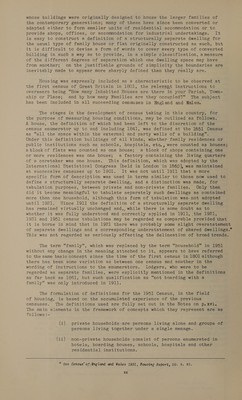
![Census 1951], Housing Report Commentary CHAPTER I: INTRODUCTION The 1951 Census of England and Wales was taken as at midnight on Sunday April 8th, the record relating to all persons present in the country at midnight, April 8th/9th, including temporary visitors but excluding residents of England and Wales who were not in the country at the time. The treatment of persons arriving in or departing from the country,. and of persons on coastwise or fishing voyages, on April 8th or 9th, is explained in the Notes on p.ix. The total population enumerated excludes members of the Armed Forces and Mercantile Marine who were outside the country, and in this respect omits a number of persons who belonged to families living in the country. As on previous occasions the census was also taken on a de facto basis in the sense that visitors in private households were included in the census statistics in the households in which they were enumerated, no details being transferred to the households to which they belonged. The choice of date was made with the object of securing a record in which as many persons as possible were enumerated at their usual places of residence: it was thought that Sunday would be the best day of the week on that account, and that, a fortnight after Easter, comparatively few people would be on holiday or away from home for other reasons at that time of year. The census record was obtained on household schedules, the head of every household being responsible for completing a schedule in respect of all persons enumerated in his or her household. Private and non-private households were distinguished in the census office on the basis of inform- ation on the schedules or in the enumeration books. Among the items of information which the head of every household was required to furnish was the relationship to him (if any) of all other persons enumerated in his household and the identification as 'visitors' of persons not usually res- ident in it. He was also required to give certain particulars about domestic. arrangements obtaining in the dwelling accommodation occupied by his household. As at the 1921 and 1931 censuses responsibility for rec- ording numbers of rooms in each dwelling and, in the case of dwellings Occupied by more than one household, in the occupation of each private household, was laid on the census enumerator who also collected particulars of vacant dwellings and of the numbers of rooms they contained. The two main concepts which are the basis of the part of the census record which relates to housing are that of a private household and that of a dwelling for the occupation of a private household or households. The formulation of definitions of these terms, in a form suitable for use by census enumerators, is difficult and has always been one of the main problems of those responsible for taking censuses which cover housing, both in. this country and elsewhere, on account of the very wide variety of housing conditions. In present day Britain the majority of the population live in types of private household comprising family (ite. related by blood or marriage) groups with each household occupying a whole dwelling. There are, however, many private households which contain persons unrelated to the head and the borderline between a private household and, e.g., a small boarding house is not always easy to define so sharply that two dif- ferent observers will infallibly treat the same establishment in the same way. Neither is it always easy to decide whether unrelated, and in some cases related, persons should be regarded as part of a household, or as a separate household living in the same dwelling - there may sometimes be doubt as to whether a person is a boarder (and therefore part of the household) or a lodger (and a separate household). The dwellings in which private households live are also of very varied types, particularly in those older parts of the larger cities and. towns](https://iiif.wellcomecollection.org/image/b32183240_0025.jp2/full/800%2C/0/default.jpg)




 No text description is available for this image
 No text description is available for this image
 No text description is available for this image