Census 1951, England and Wales : housing report.
- General Register Office Northern Ireland
- Date:
- 1956
Licence: Public Domain Mark
Credit: Census 1951, England and Wales : housing report. Source: Wellcome Collection.
66/290
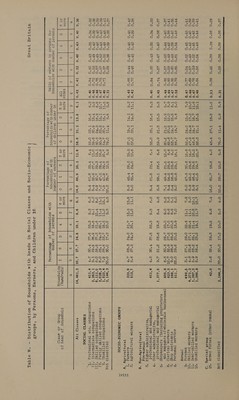
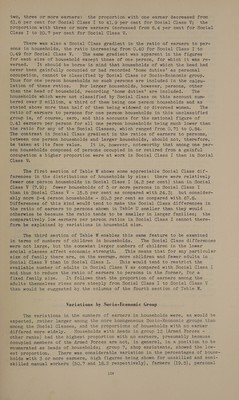
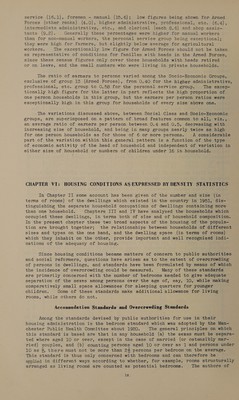
![service (16.1), foremen - manual (15.6); low figures being shown for Armed Forces (other ranks) (4.0), higher administrative, professional, etc. (6.4), intermediate administrative, etc., and clerical (each 8.6) and shop assis- tants (9.2). Generally these percentages were higher for manual workers than for non-manual workers, the personal service group being exceptional; they were high for farmers, but slightly below average for agricultural workers. The exceptionally low figure for Armed Forces should not be taken as representative of conditions for families with heads in the Armed Forces, since these census figures only cover those households with heads retired or on leave, and the small numbers who were living in private households. The ratio of earners to persons varied among the Socio-Economic Groups, exclusive of group 13 (Armed Forces), from 0.40 for the higher administrative, professional, etc. group to 0.58 for the personal service group. The excep- tionally high figure for the latter in part reflects the high proportion of one person households in this group, but the earners per person ratios were exceptionally high in this group for households of every size above one. The variations discussed above, between Social Class and Socio-Economic groups, are superimposed on a pattern of broad features common to all, viz., an average ratio of earners per person between 0.4 and 0.5, decreasing with increasing size of household, and being in many groups nearly twice as high for one person households as for those of 6 or more persons. A considerable part of the variation within this general pattern is a function of the type of economic activity of the head of household and independent of variation in either size of household or numbers of children under 16 in household. CHAPTER VI: HOUSING CONDITIONS AS EXPRESSED BY DENSITY STATISTICS In Chapter II some account has been given of the number and size (in terms of rooms) of the dwellings which existed in the country in 1951, dis- tinguishing the separate household occupations of dwellings containing more than one household. Chapters III and IV have analysed the households which occupied these dwellings, in terms both of size and of household composition. In the present chapter these two broad aspects of the housing of the popula- tion are brought together; the relationships between households of different sizes and types on the one hand, and the dwelling space (in terms of rooms) which they inhabit on the other, provide important and well recognised indi- cations of the adequacy of housing. Since housing conditions became matters of concern to public authorities and social reformers, questions have arisen as to the extent of overcrowding of persons in dwellings, and standards have been formulated by means of which the incidence of overcrowding could be measured. Many of these standards are primarily concerned with the number of bedrooms needed to give adequate separation of the sexes among persons over the age of, say, 10, while making comparatively small space allowances for sleeping quarters for younger children. Some of these standards make additional allowance for living rooms, while others do not. Accommodation Standards and Overcrowding Standards Among the standards devised by public authorities for use in their housing administration is the bedroom standard which was adopted by the Man- chester Public Health Committee about 1920. The general principles on which this standard is based are that in any household (a) the sexes must be separa- ted where aged 10 or over, except in the case of married (or ostensibly mar- ried) couples, and (b) counting persons aged 10 or over as 1] and persons under 10 as 3, there must not be more than 24 persons per bedroom on the average. This standard is thus only concerned with bedrooms and can therefore be applied in different ways according to whether, for example, rooms structurally arranged as living rooms are counted as potential bedrooms. The authors of 1x](https://iiif.wellcomecollection.org/image/b32183240_0066.jp2/full/800%2C/0/default.jpg)
 No text description is available for this image
 No text description is available for this image
 No text description is available for this image