Census 1951, England and Wales : housing report.
- General Register Office Northern Ireland
- Date:
- 1956
Licence: Public Domain Mark
Credit: Census 1951, England and Wales : housing report. Source: Wellcome Collection.
72/290
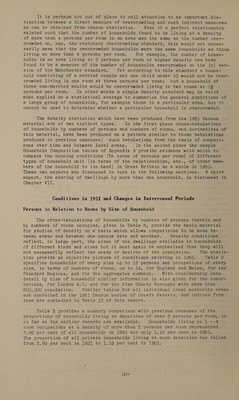
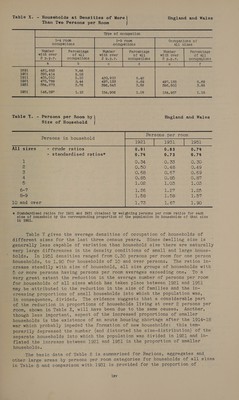
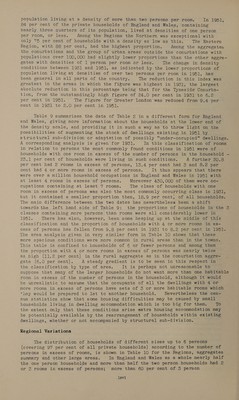
![84 per cent of the private households of England and Wales, containing nearly three quarters of its population, lived at densities of one person per room,’ “or less, Among the Regions the Northern was exceptional with only 75 per cent of households with a density as low as this. The Eastern Region, with 88 per cent, had the highest, proportion. Among the aggregates the conurbations and the group of urban areas outside the conurbations with populations over 100,000 had slightly lower proportions than the other aggre- gates with densities of 1 person per room or less. The change in density conditions between 1931 and 1951, as indicated by the lower proportions of population living at denéities of over two persons per room in 1951, has been general in all parts.of the country, The reduction in this index was greatest in the areas in which the figure was highest in 1931, the largest absolute reduction in this percentage being that for the Tyneside Conurba- tion, from the outstandingly high figure of 24.0 per cent in 1931 to 6.2 per cent in JO5i. The figure for Greater London was reduced from 9.4 per cent) in 19317 16+2,0.per. centlins 1951, Table 9 summarises the data of Table 2 in a different form for England and Wales, giving more information about the households at the lower end of the density scale, and providing it in such a way as to throw light on the possibilities of augmenting the stock of dwellings existing in 1951 by structural sub-division or adaptation of possibly “under-occupied dwellings. A corresponding analysis is given for 1931. In this classification of rooms in relation to persons the most commonly found conditions in 1951 were of households with one room in excess of the number of persons in the household - 25.1 per cent of households were living in such conditions. A further 20.8 per cent had 2 rooms in excess of persons, 135.4 per cent had 3 and 8.2 per cent had 4 or more rooms in excess of persons. It thus appears that there were over a million household occupations in England and Wales in 1951 with at least 4 rooms in excess of persons. Moreover 430,000 of them were oc- cupations containing at least 7 rooms. The class of households with one room in excess of persons was also the most commonly occurring class in 1931, but it contained a smaller proportion then, 18.9 per cent, of all households. The main difference between the two dates has nevertheless been a shift towards the left hand side of Table 9: the proportions of households in the 3 classes containing more persons than rooms were all considerably lower in 1951. There has also, however, been some heaping up at the middle of this classification and the proportion of households with 4 or more rooms in ex- cess of persons has fallen from 9.8 per cent in 193] to @.2 per Cent sine. The area analysis given in very similar form in Table 10 shows that these more spacious conditions were more common in rural areas than in the towns. This table is confined to households of 6 or fewer persons and among them the proportion with 4 or more rooms in excess of persons was nearly twice as high (11.2 per cent) in the rural aggregate as in the conurbation aggre- gate (6.0 per cent). A steady gradient is to be seen in this respect in the classification by type. of area. It is perhaps not unreasonable to suppose that many of the larger households do not want more than one habitable room in excess of the number of persons in the household, although it would be unrealistic to assume that the occupants of all the dwellings with 4 or more rooms in excess of persons have sets of 3 or more habitable rooms which +hey would be prepared to let to another household. Nevertheless the cen- sus statistics show that some housing difficulties may be caused by small households living in dwelling accommodation which is too big for them. To the extent only that these conditions arise extra housing accommodation may be potentially available by the rearrangement of households within existing dwellings, whether or not accompanied by structural sub-division. Regional Variations The.distribution of households of different sizes up to 6 persons (covering 97 per cent of all private households) according to the number of persons in excess of rooms, is shown in Table 10 for the Regions, aggregates summary and other large areas. In England and Wales as a whole nearly half the one person households and more than half the two person households had 2 or 3 rooms in excess of persons; more than 60 per cent of 3 person lxvi](https://iiif.wellcomecollection.org/image/b32183240_0072.jp2/full/800%2C/0/default.jpg)
 No text description is available for this image
 No text description is available for this image
 No text description is available for this image