The chronography of Gregory Abû'l Faraj, the son of Aaron, the Hebrew physician, commonly known as Bar Hebraeus : being the first part of his political history of the world / translated from the Syriac by Ernest A. Wallis Budge.
- Bar Hebraeus
- Date:
- 1932
Licence: Public Domain Mark
Credit: The chronography of Gregory Abû'l Faraj, the son of Aaron, the Hebrew physician, commonly known as Bar Hebraeus : being the first part of his political history of the world / translated from the Syriac by Ernest A. Wallis Budge. Source: Wellcome Collection.
90/676 page 4
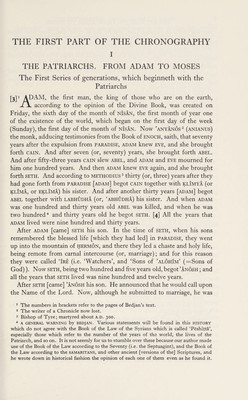
![not neglectful in pleasing God, and he did so more than those who chose a life of virginity and who went up into [the mountain of hermon] but who did not abide in (i.e. keep) their covenant, ’anosh was one hundred and ninety years old when he begot kainan, and all his years were nine hundred and five. After ’anosh [came] kainan his son, who at the age of one hundred and seventy years begot mahlala’il; and all the years of his life were nine hundred and ten years. And after kainan [came] mahlala’il his son, who at the age of one hundred and sixty-five years begot yard ; and all the years of his life were eight hundred and ninety-five years. And after mahlala’il [came] yard his son, who, when he was one hun¬ dred and sixty and two years old begot hanokh (enoch) ; and all the years of his life were nine hundred and sixty and two years. And in the fortieth year [of the life] of yard, that is to say in the year one thousand of the world, the Sons of God, about two hundred souls, came down from the mountain of hermon, because they had lost all hope of a return to paradise. And because they lusted for carnal intercourse with women, their brethren the sons of seth and anosh despised them, and regarded them as trans¬ gressors of the covenant, and they refused to give them their daughters. And because of this they (i.e. the men from hermon) went to the children of cain, and took wives, and begat mighty men of names, that is to say, men notorious for murders and robberies. Moreover, they set up over them the first king, a man whose name was samyazos, and when they began to quarrel with their brethren the children of seth, they forced them also to set up a king over them, and they set up a king. The first was a man whose name was ’aloros. And the second was ’alparos. And the third was ’almilon. And the fourth was ’ammanon. And the fifth was mighalaros. And the sixth was ’aonos, the shepherd. [5] And the seventh was ’aodhoranbos. And the eighth was ’ampesis. And the ninth was ’aotyartis. • • And the tenth was ksIsothros (or KsisoRraos) his son, in whose days the flood took place. All these were khaldhaye, that is to say ancient Syrians, according to the tradition of the early writers. And because the greater number of [these] writers were Greeks, they changed the sounds of the Chaldean names and did not pronounce them as they were pronounced in Chaldean fashion. For behold, also, in the case of ‘noh’ (noah), which is a pure Syrian name, and is derived from nawha, yet they (i.e. the Greeks) call it](https://iiif.wellcomecollection.org/image/b31365334_0090.jp2/full/800%2C/0/default.jpg)