The physiological action of choline and neurine / by F.W. Mott and W.D. Halliburton.
- Frederick Walker Mott
- Date:
- 1899
Licence: Public Domain Mark
Credit: The physiological action of choline and neurine / by F.W. Mott and W.D. Halliburton. Source: Wellcome Collection.
Provider: This material has been provided by The Royal College of Surgeons of England. The original may be consulted at The Royal College of Surgeons of England.
4/60 page 212
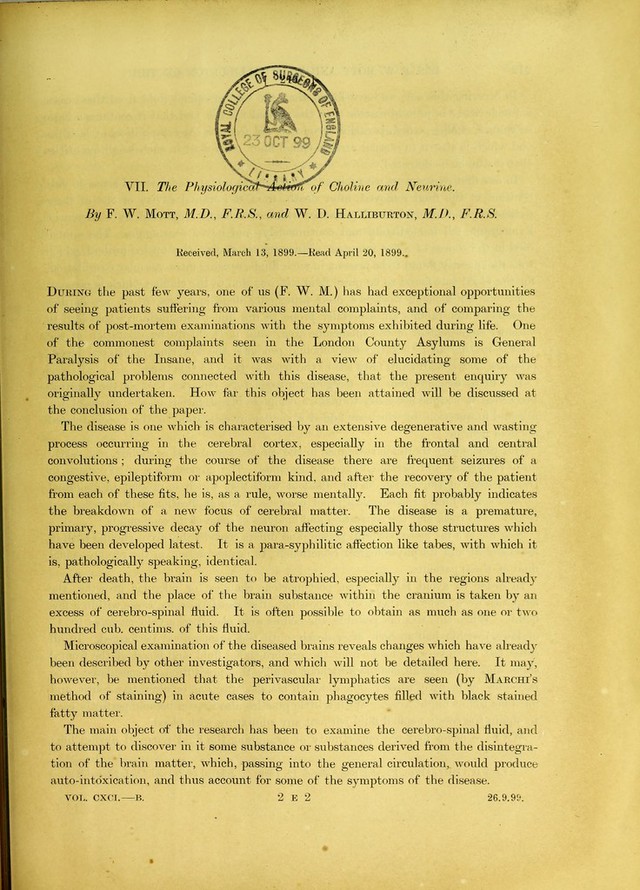
![In carrying this ont, we have found tliat the cerebro-spinal fluid from these cases is much richer in proteid matter than the normal fluid is, and tliat it contains a basic substance, choline, which is easily accounted for from the decomposition of lecithin, and which is absent in normal cerel)ro-spinal fluid, or present in sucli small quantities that it cannot be detected. In our first experiment we took an ansesthetised rabbit, and injected some 30 cub. centims. of the fluid removed, after death, from the ci'cinial cavity of one of these patients. The arterial blood pressui'e, which was being registei'ed by a mei'curial kymograph, fell immediately and continuously, and never inse again. The animal died in the course of a few minutes. This was not due to the nucleo-proteid, which Ave subsequently found to be present in such fluids, causing intra-vascular coagulation, for the blood Avas f(Aund to be quite fluid ; it was due to the choline AAdiich is present. In our subsequent Avork Ave iised ])rincipally dogs and cats, Avhich are hardier animals; hutch rabbits are especially prone to die under circumstances that lead to Avascular engorgement of the splanchnic area,'^ and it is chiefly by dilatation of the A’essels in this area that the base choline produces the loAvering of arterial blood- pressAire, as Ave shall more fully see in the later sections of this paper. It Avill he evident from the foregoing introductory remarks, that as the research proceeded it became necessary to make a complete investigation of the action of the alkaloid in question, to Avhich Ave added a similar investigation of the closely, related alkak)id neurine. Our proofs that the toxic substance in the cerebro-spinal fluid is choline, rest partly on physiological and partly on chemical grounds. The })hysiological proof consists in the identity of the action of the alkaloid Avith that AAdiich is present in abnormal cerebro-spinal fluid ; the chemical pi'oof consists in the application of the recognised tests for the base, and the separation and analysis of some of its compounds. Neurine is a far more poAverful poison, and difters considerably from choline lioth in its chemical and its physiological re-actions. It is not present in the cerebro-spinal fluid of these patients. In order to avoid fallacy from post-mortem changes, or microbic groAvths, the autopsies were performed as soon as possible after death, in some cases within a feAv hours. When this Avas not possible, the bodies Avere placed in a cold chamber (0° C. or loAver) Avithin half an hour after death, until the autopsy Avas performed. In all cases, too, cultures Avere made from the cerebro-spinal fluid, and blood of the frontal sinus, and in nearly all instances Avithout result ; this precaution Ave considered to be necessary, as many of these people die Avith bladder atfection, or ulcerative colitis, and microbic toxins might arise. With a little practice also it soon became perfectly easy to obtain the cerebro-spinal fluid Avithout any admixture Avith blood. We have never had the opportunity of examining the fluid removed during life ; LEONAim Hill, ‘ Proc. Physiol. Soc.,’ March 12, 1898. (‘ Journal ol Physiol.,’ vol. 22, j). liii.)](https://iiif.wellcomecollection.org/image/b22392695_0006.jp2/full/800%2C/0/default.jpg)