Materia medica, pharmacy, pharmacology and therapeutics / by W. Hale White.
- William Hale-White
- Date:
- 1901
Licence: In copyright
Credit: Materia medica, pharmacy, pharmacology and therapeutics / by W. Hale White. Source: Wellcome Collection.
Provider: This material has been provided by The University of Leeds Library. The original may be consulted at The University of Leeds Library.
139/680 page 165
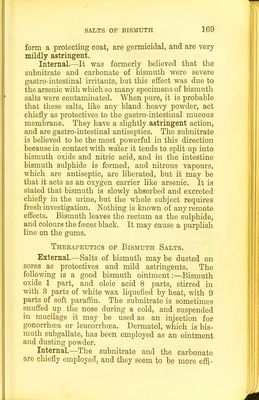
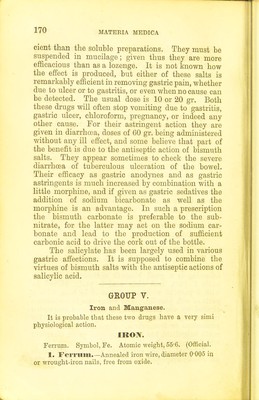
![Calamine (purified zinc carbonate) is an excellent slight astringent for skin diseases. An ointment (1 to 5 of benzoated lard) or a lotion (calamine, 15 gr.; zinc oxide, 15 gr.; lime water, 80 ni; glycerin, 20 iii; •water, 1 fl. oz.) are good preparations. Intev]i9l.—Ali7nentary canal—On ^ account of their disagreeable taste, solutions of zinc salts are not used as astringents to the mouth. Small doses of the oxide or sulphate may be given as astringents in diarrhcea. The sulphate is a very good emetic for cases of poisoning, for it acts promptly without causing much nausea and hardly any depression. It is occasionally given as an emetic to children suffering from laryngitis or bronchitis. Beviote effects Because it is believed to act as a depressant to the nervous system, zinc sulphate has been given in hysteria, epilepsy, whooping- cough, and chorea in doses of 1 to 3 grains thrice a day. Its use is now generally limited to chorea, but often its effect is so slow that it is difficult to prove that the patient would not have improved quite as rapidly without any drug. It is usually said to be a tonic, but there is no trustworthy evidence for this statement. The oxide given internally will occasionally check the night-sweats of phthisis. CUPRUM. Copper. Symbol, Cu. Atomic -weight, 63'12. (Not official.) Cupri Sulphas.—Copper Sulphate. CuSO„5H.O Synonyms.—Blue vitriol; Bluestone ; Cnpric sulphate. Source.—Obtained by the interaction of water, cuprio oxide or copper and sulphuric acid. Chaeacters.—Deep blue crystals in triclinic prisms. Taste, styptic. Solubility.—1 in 3'5 of water. Solution strongly acid. Impurity.—Iron. Incompatibles.—Alkalies and their carbonates, lime water, mineral salts (except sulphates), iodides, and most vegetable astringents. Dqse, J to 2 gr. (astringent); 5 to IQ gr. (emetic).](https://iiif.wellcomecollection.org/image/b21507260_0141.jp2/full/800%2C/0/default.jpg)