Materia medica, pharmacy, pharmacology and therapeutics / by W. Hale White.
- William Hale-White
- Date:
- 1901
Licence: In copyright
Credit: Materia medica, pharmacy, pharmacology and therapeutics / by W. Hale White. Source: Wellcome Collection.
Provider: This material has been provided by The University of Leeds Library. The original may be consulted at The University of Leeds Library.
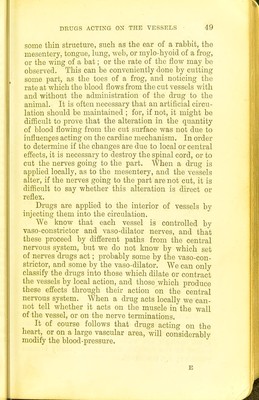
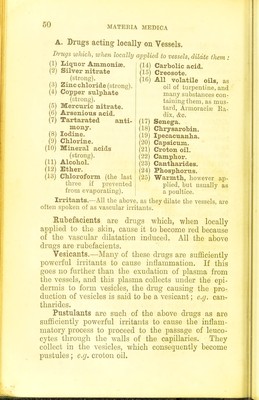
69/680 page 47
![Drugs the cliicf action ofiuhich is to decrease the force of the contraction, usually with stoppage in diastole : (1) Dilvite acids. (2) Sti-ong- solutions of salts of the alka- line metals. (3) „ of barium salts. (4) „ of copioer double salts. (5) „ of zinc double salts. Strongf solutions of chloral. (7) Muscarine. Pilocarpine. Saponine (large doses). (6) (8) (9) (10) Apomorphine. (11) Emetine. (12) Salicylic acid (large doses).. Drugs an important action of ivhichis to increase the rate of the cardiac beat: (1) Atropine. (2) Hyoscyamine. (3) Daturine. ('!) Diiboisine. (5) Cocaine. (6) Sparteine. (7) Saponine. Drugs an important action of luhich is to sloio the rate of the cardiac heat (see also first list given above) : (1) Muscarine. ] (2) Pilocarpine. Drugs luhich increase both the force and the number of the beats : (1) Alcohol. (2) Ether. (3) Chloroform. (4) Anaesthetics. (5) Arsenical salts. (6) Quinine. (7) Strychnine. Drugs lohich decrease both the force and tlic number of the beats: (1) Antimony salts. (2) Aconite. (3) Hydrocyanic acid. (4) Ergot. (5) Vcratriuo. B. Drugs acting on the Vagus Centre.~If we observe that the giving of a drug to an animal alters tlie beat of the heart, but that this alteration can be done away with, either by cutting the vagi or stimu- lating the peripheral end of the nerve—if one only of them be cut—we may conclude that the drug acted on the vagus centre in the medulla.](https://iiif.wellcomecollection.org/image/b21507260_0069.jp2/full/800%2C/0/default.jpg)