Notes of lectures on the theory and practice of medicine : delivered in the Jefferson Medical College, at Philadelphia / by John Eberle, M. D.
- John Eberle
- Date:
- 1834
Licence: Public Domain Mark
Credit: Notes of lectures on the theory and practice of medicine : delivered in the Jefferson Medical College, at Philadelphia / by John Eberle, M. D. Source: Wellcome Collection.
Provider: This material has been provided by the National Library of Medicine (U.S.), through the Medical Heritage Library. The original may be consulted at the National Library of Medicine (U.S.)
39/224
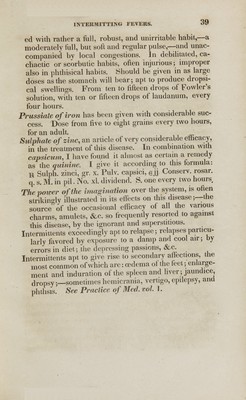
![Compression by the tourniquet, has been found useful to put a stop to this stage. [Kellie.] Its modus operandi explained. Treatment in the hot stage. The object is to moderate the violence of the febrile reaction, and to hasten the supervention of the sweating stage. The remedies employed for this purpose are: bleeding in cases of vio- lent reaction, cool diluent drinks, and the usual anti- phlogistic remedies. A draught of cold water, when the skin is very dry and hot, is both grateful and bene- ficial, predisposing to perspiration. Emetics not pro- per in this stage. Excessive vomiting best checked by opium and the effervescing draught. Opium highly recommended in this stage, by Dr. Lincl; injurious in intermittents of a marked phlogistic character; highly useful in cases of feeble reaction. Not often necessary to use remediate treatment, in this stage. [Pract. Med. p. 32.] Treatment during the Intermission. It is in this stage, that the radical cure of the disease is to be attempted. In prescribing with this view, attention must be paid to the four modifications described above. In inflammatory intermittents, the febrifuge tonics are not to be used, until the phlogistic state of the system has been reduced by a strict antiphlogistic treatment. (Pract. Med. p. 84.) In the congestive and malignant modifications, stimu- lants and tonics must be resorted to, early and freely. (Pract. Med. p. 75.) In Ihe gastric modification, emetics and cathartics are important preliminary remedies. Cinchona—the most efficacious tonic febrifuge we pos- sess—must be employed during the apyrexia. Not to be employed, where a phlogistic diathesis prevails— that is, where the pulse is tense and quick, with a feel- ing of general uneasiness, head-ache, dry and warm skin, are present in the intermission; in such case, anti-](https://iiif.wellcomecollection.org/image/b21117573_0039.jp2/full/800%2C/0/default.jpg)
 No text description is available for this image
 No text description is available for this image
 No text description is available for this image