Notes of lectures on the theory and practice of medicine : delivered in the Jefferson Medical College, at Philadelphia / by John Eberle, M. D.
- John Eberle
- Date:
- 1834
Licence: Public Domain Mark
Credit: Notes of lectures on the theory and practice of medicine : delivered in the Jefferson Medical College, at Philadelphia / by John Eberle, M. D. Source: Wellcome Collection.
Provider: This material has been provided by the National Library of Medicine (U.S.), through the Medical Heritage Library. The original may be consulted at the National Library of Medicine (U.S.)
50/224
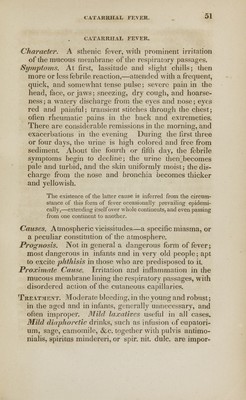
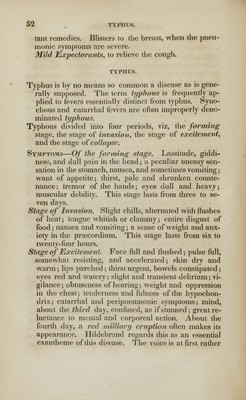
![called burning. Delirium not a common symptom. The pulse seldom beats more than 110 in a minute. The blood, when drawn, separates rapidly into its con- stituent parts—the crassamentum contracting into a firm mass, on the top of which a yellowish mass of fi- brine collects, forming what is termed the buffy coat, or inflammatory crust. Pract of Med. p. 129. A somewhat similar covering is sometimes formed on the blood of typhous patients. The inflammatory buff has a uniformly yellowish ■white appearance. That which is sometimes seen on the blood of typhous patients, presents an iridescent ap- pearance—reflecting the colors of the rainbow, when held in certain positions. It is also much more brittle in its texture, than the former. [Richter.] Inflammatory fever never very protracted in its course; generally terminates in some manifest critical dis- charge ; haemorrhage from the nose, and increased flow of sweat the most common. Most apt to occur in per- sons of robust and vigorous constitutions, and between the ages of twenty and forty. Cause. The most common causes are: Atmospheric vi- cissitudes ; violent passions; wounds and other injuries; a peculiar atmospheric constitution. Sudden sup- pression of perspiration by cold, is however the most common sporadic cause. Hence, inflammatory fevers most prevalent in cold and variable climates, or during the spring of temperate latitudes; more prevalent also in elevated, dry, and sandy situations, than in localities of an opposite character. Pract. of Med. p. 140. Diagnosis between sthenic and asthenic fevers some- times very difficult. The constitution and habits of the patient, the nature of the predisposing and exciting causes, will aid us in the diagnosis. In very doubtful cases, we must have re- course to the indices ex nocentibus et juvantibus— the indications drawn from the effects of immediate agents. Prognosis. Simple inflammatory fever, the least dan-](https://iiif.wellcomecollection.org/image/b21117573_0050.jp2/full/800%2C/0/default.jpg)
 No text description is available for this image
 No text description is available for this image
 No text description is available for this image