The anatomy and diseases of the breast / By Sir Astley Cooper, bart ... To which are added, his various surgical papers, now first published in a collected form.
- Astley Cooper
- Date:
- 1845
Licence: Public Domain Mark
Credit: The anatomy and diseases of the breast / By Sir Astley Cooper, bart ... To which are added, his various surgical papers, now first published in a collected form. Source: Wellcome Collection.
Provider: This material has been provided by the University of Massachusetts Medical School, Lamar Soutter Library, through the Medical Heritage Library. The original may be consulted at the Lamar Soutter Library at the University of Massachusetts Medical School.
96/538 (page 92)
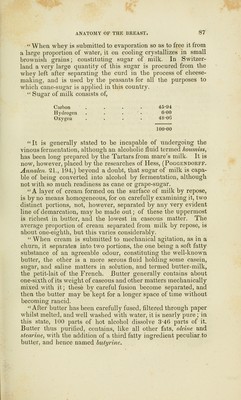
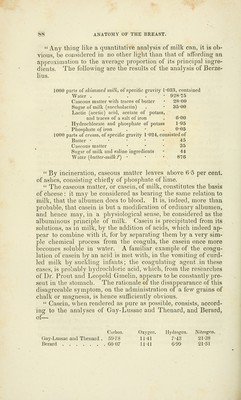
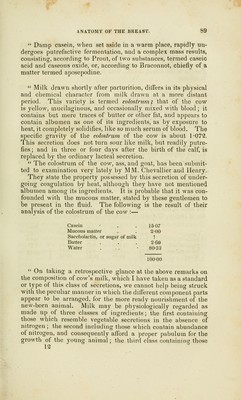
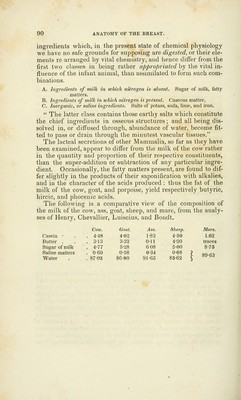
![state of the breast, and of producing the secretion of nnilk, consists ill the application of the child to the nipples, which encourages the secretion, and this should be done so soon as the fatitrue of delivery is passed. It has the additional advantage of drawing out and elongating the nipple, and of fitting it for its future office, an attention which is frequently required after a first delivery. If the child be too weak to perform this office, the nurse sup- plies its ])lace, and sucks the mother, or uses a pump to draw off the secretion. But if the breast continues swollen and inflamed, and the milk does not appear, purgatives and leeches will be required to lessen the inflammation and excitement of the con- stitution, and fomentations and poultices will be necessary upon the breasts to encourage and assist in the production of the secretion. The secretion of milk may be said to be constant or occasional; by the first, the milk tubes and reservoirs are constantly sup- plied by means of a slow and continued production of the fluid, so that the milk is thus, in some degree, prepared for the child. By the occasional, is to be understood that secretion which is called by mothers and nurses, the draught of the breast, by which is meant a sudden rush of blood to the gland, during which the milk is so abundantly secreted, that if the nipple be not immediately caught by the child, the milk escapes from it, and the child when it receives the nipple is almost choked by the rapid and abundant flow of the fluid; if it lets go its hold, the milk spirts into the infant's eyes. Even the sight of the child will produce this draught, or sudden rush of blood and copious supply of milk, as the thought or sisrht of food occasions an abundant secretion of the saliva. The draught is also greatly increased by the child pressing the breast with its little hands, by its drawing out the nipple by its tongue, lips, and gums, and by the pressure of its head against the breast. In other mammalia, so far as we can judge, a similar process occurs, and the same effect is produced by the animal striking the udder with its head, and forcibly drawing out the teat. Observe the foal playing with the teat, drawing it out forcibly and striking the udder of the mare with its head; and the lamb sucking for a short time to empty the large reservoir of the gland of the accumulated milk, and then beating the udder of the ewe with its head as if to put it in mind of secreting more to supply its still pressing wants. In the human subject the milk is often so abundant, that a](https://iiif.wellcomecollection.org/image/b21196783_0096.jp2/full/800%2C/0/default.jpg)