Copy 1
Outlines of the course of qualitative analysis followed in the Giessen laboratory / By Henry Will ; With a preface by Baron Liebig.
- Heinrich Will
- Date:
- 1846
Licence: Public Domain Mark
Credit: Outlines of the course of qualitative analysis followed in the Giessen laboratory / By Henry Will ; With a preface by Baron Liebig. Source: Wellcome Collection.
117/152 page 101
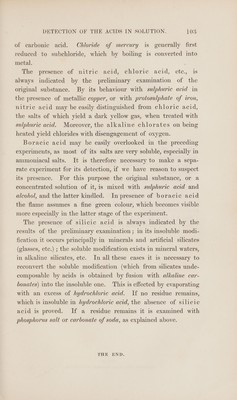
![ing an excess of ammonia, gives a white precipitate with sulphate of lime, which is insoluble in acetic acid, but dissolves readily in nitric acid and hydrochloric acid. The presence of tartaric acid is ascertained by treating with potassa in the cold, the precipitate obtained by chloride of calcium and ammonia, after it has been washed and filtered off. If the precipitate consists entirely of tartrate of lime, it is completely redissolved ; in case how- ever a residue is left (oxalate or phosphate of lime, fluoride of calcium), the potassa solution is filtered off and boiled for some time. Tartrate of lime is repreci- pitated in this manner. Citric and [malic] acids, if present, are contained in the liquid filtered off from the precipitate, which chloride of calcium and ammonia produced. The lime salts of these acids may be precipitated from this liquid by alcohol, citrate of lime also by ebullition. We must observe in this case, that if sulphuric acid be present alcohol produces always a preci- pitate of sulphate of lime, which however by its comport- ment when ignited cannot be confounded with citrate and malate of lime. If a salt of these organic acids, and espe- cially of oxalic and tartaric acid is to be examined, which is insoluble in water but dissolves in acids, the process for ascertaining them above described cannot be used, as from an acid solution the salt is entirely reprecipitated on addition of ammonia. In this case the organic acid of these salts msoluble in water is easily withdrawn by boiling with carbonate of potassa, or carbonate of soda. We have now a salt soluble in water, the acid of which may be easily ascertained by neutralising the liquid with hydrochloric acid, and following the course above explained. : The presence of sulphuric [and selenic] acid has been indicated by the baryta precipitate, msoluble in hydrochloric acid. For phosphoric acid we test separately by adding to the original aqueous solution a mixture of sulphate of magnesia, chloride of ammonium, and ammonia, by which a precipitate of phosphate of magnesia and ammonia js obtained ; if the](https://iiif.wellcomecollection.org/image/b33097847_0001_0117.jp2/full/800%2C/0/default.jpg)
 No text description is available for this image
 No text description is available for this image
 No text description is available for this image